Police encounters · Traffic-stop procedures
Why Do Police Approach a Car From the Passenger Side?
Police may approach from the passenger side for traffic safety, visibility and tactical reasons. Learn what official vehicle-stop training says and what drivers should do.
Independent educational reference. Not a police agency, hiring decision, or legal opinion.How we use sources.
Why do police approach some cars from the passenger side?
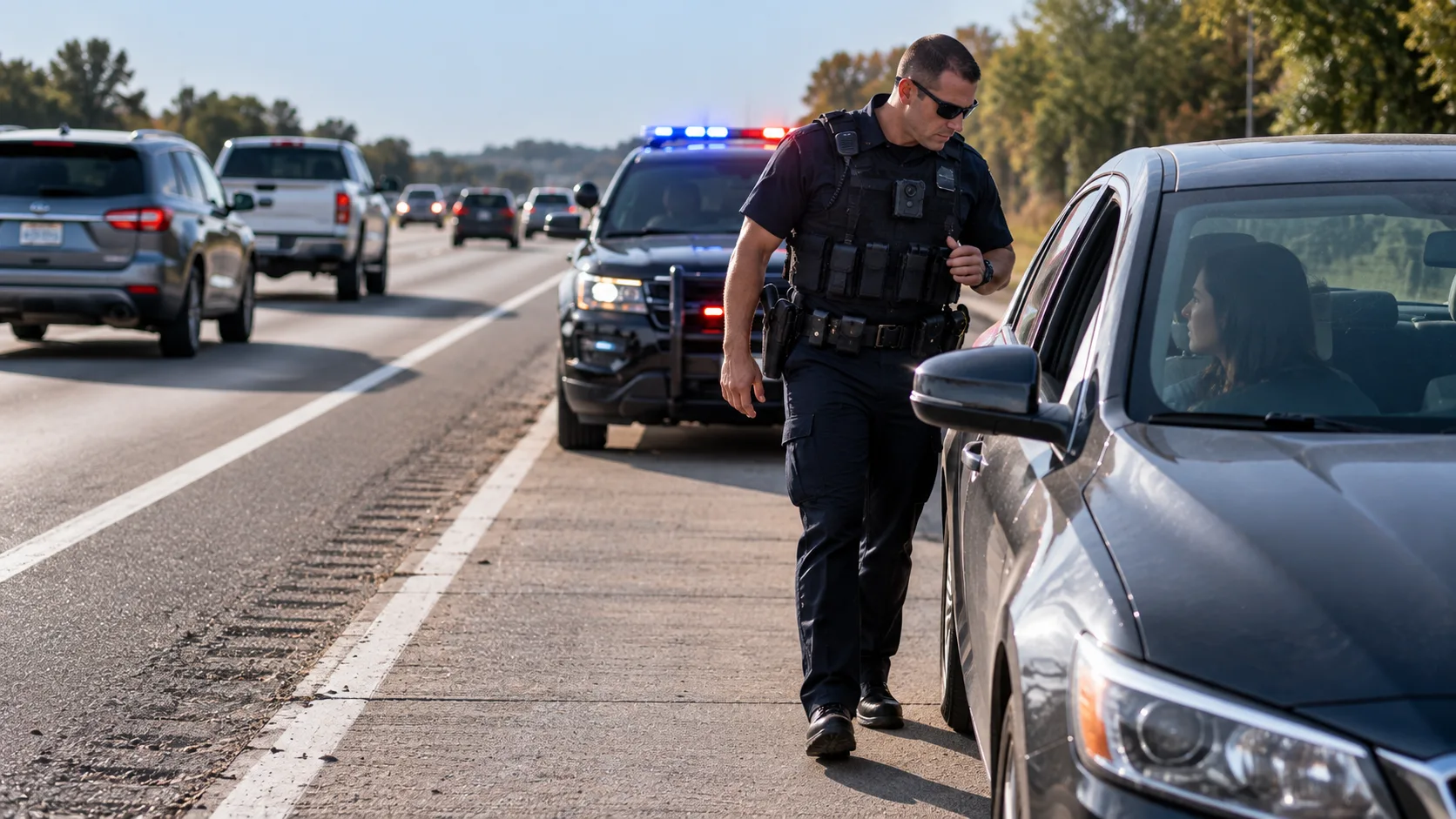
Drivers often expect an officer to walk directly to the driver's window after a traffic stop. When the officer instead appears at the passenger-side window, the change can feel unusual or even suspicious.
Police training materials show that the tactic has ordinary officer-safety reasons. TheCalifornia POST vehicle-pullover workbooktells officers to consider varying their vehicle approach. It specifically says a passenger-side approach can give an officer a different view into the passenger compartment and may be safer on a freeway or busy street.
Florida's basic recruit training material gives a similar explanation. It notes that vehicle occupants commonly expect the officer to approach from the driver's side. Approaching from the passenger side can give the officer additional time to listen and observe what is happening inside the vehicle.
The tactic therefore is not evidence by itself that something unusual has been discovered. It can simply be the officer's chosen approach for that roadway and stop.
The passenger side can reduce exposure to passing traffic
One of the simplest reasons is roadway safety.
On many U.S. roads, the driver's side of a stopped vehicle is closest to active traffic. An officer standing beside the driver's door can be only a short distance from vehicles traveling at highway speed.
California POST specifically identifies the passenger-side approach as a possible safer alternative when a vehicle pullover occurs on a freeway or busy street.
Moving to the passenger side can place the stopped vehicle itself between the officer and at least some of the passing traffic. That does not eliminate roadway danger, but it can reduce direct exposure in certain stop locations.
This also helps explain why the same officer may use different approaches on different stops. A quiet residential street, a narrow shoulder, an interstate, a multi-lane urban road, and a parking lot create very different physical environments.
Do not assume the officer must always come to the window nearest you. The officer may be choosing the side that offers the best combination of visibility, space, cover, communication, and traffic protection.
A passenger-side approach gives the officer a different view inside the car
Vehicle interiors contain blind spots. What an officer can see from the driver's side is not necessarily what can be seen from the passenger side.
California POST says a passenger-side approach can give an officer a different viewing angle into areas such as the floorboards, passenger seat, and the driver's hands or objects the driver may be holding.
Florida training material similarly explains that the different approach can help an officer observe whether a driver is concealing something on the right side of the vehicle.
This does not mean the officer has already concluded that drugs, alcohol, a weapon, or other evidence is present. It means the officer is using position and observation as part of the stop.
Observation begins before the officer reaches either window. Training commonly teaches officers to watch the vehicle, occupants, rear area, windows, movement, and surroundings throughout the approach.
That is also why sudden reaching or searching inside the vehicle can create uncertainty. If you need to retrieve a license, registration, or insurance information, explain where the item is before reaching for it.
Why does an unexpected approach help the officer?
Occupants commonly expect police to appear at the driver's window. Official training recognizes that expectation.
California POST describes the passenger-side approach as giving the officer an element of surprise. Florida's training material similarly says occupants will often expect the officer to approach from the driver's side.
The practical value is not about startling a cooperative driver for entertainment or intimidation. It is about making the officer's movement less predictable while allowing observation from another angle.
If an occupant is trying to hide an object specifically from an officer expected at the driver's window, a passenger-side approach may reveal behavior or areas that would be harder to observe from the expected position.
At the same time, a routine passenger-side approach should not be described as proof that the officer believes the driver is dangerous. Officers can use the tactic proactively rather than in response to a specific threat.
Why don't police always approach from the passenger side?
No single approach is best for every stop.
A passenger-side approach can itself have disadvantages. The shoulder may be narrow, blocked, steep, muddy, fenced, or exposed to another hazard. The passenger window may be closed or difficult for communication. The vehicle may be positioned close to a barrier.
Occupant location can also matter. A vehicle with multiple passengers presents a different situation from a vehicle with one driver. Lighting, weather, road design, visibility, backup officers, and information known before the stop can all affect the decision.
California POST's broader guidance is to vary the vehicle approach and maintain a position of advantage. That wording is important because it treats the passenger side as an available tactic rather than a mandatory national procedure.
Florida's training material also includes a no-approach option for situations where an officer does not feel safe walking to the stopped vehicle.
A driver should therefore expect traffic-stop tactics to vary even within the same department.
What should the driver do when the officer approaches the passenger side?
You generally do not need to do anything unusual merely because the officer chose the passenger side.
Stop safely, place the vehicle in park, remain calm, and keep your hands visible. At night, turning on the interior light can improve visibility.
Do not suddenly lean across the center console, open the passenger door, or reach through compartments simply because the officer appears on the opposite side from where you expected.
If the officer asks you to lower the passenger-side window, do so if you can safely operate it. If the window does not work, clearly communicate that rather than making unexpected movements.
When asked for documents, explain where they are before reaching. For example, if registration is in the glove compartment directly in front of the officer, say that first.
OurTraffic Stop Rights guidecovers the separate questions of documents, questioning, searches, stop duration, and what to preserve after the encounter.
What if there is a passenger in the front seat?
The officer may be standing closer to the passenger, but that does not automatically convert the passenger into the subject of the traffic violation.
The driver remains responsible for driver-specific document duties under applicable state law. Passenger identification and detention questions can involve separate rules.
If the officer gives the passenger a direct safety instruction, the passenger should not physically resist simply because the original stop concerned the driver.
For identification questions, readDoes a Passenger Have to Show ID During a Traffic Stop?.
The passenger should also avoid reaching into bags, under seats, or into the glove compartment unexpectedly while the officer is positioned at that window.
What does a passenger-side approach not necessarily mean?
It does not necessarily mean the officer believes drugs are in the vehicle.
It does not necessarily mean the officer sees a weapon.
It does not necessarily mean a search is about to occur.
And it does not automatically mean the stop has become more serious than an ordinary traffic violation.
Official training materials support using the passenger side as a general traffic-stop tactic. The officer may simply be reducing exposure to traffic, gaining a different observation angle, or following agency or personal training.
If the encounter later develops into a frisk, search, K9 investigation, arrest, or another action, evaluate that later event separately rather than treating the approach side as its legal justification.
For example, ourK9 traffic-stop guideexplains why the timing and justification for a dog sniff are separate from ordinary vehicle-approach tactics.
What should you record after a disputed traffic stop?
If something about the encounter later matters, preserve the sequence rather than focusing only on which side the officer approached.
Record the date, time, roadway, direction of travel, reason given for the stop, agency, and what occurred as officers approached.
Note when documents were requested, whether anyone was ordered out, whether identification was requested from passengers, whether consent to search was requested, whether a frisk or search occurred, and what paperwork was issued.
Preserve original video and photographs. If there is dash-camera or body-camera footage, the agency's retention period may matter if you later decide to request a copy.
Avoid drawing a legal conclusion from one tactical detail. A timeline containing the actual words and actions is much more useful to a lawyer, court, complaint investigator, or records office.
What to do next
Police approach from the passenger side primarily because it can improve officer safety and observation. California and Florida training materials both document passenger-side vehicle approaches as legitimate traffic-stop tactics.
The approach is not universal and does not itself determine whether the stop, search, detention, or later police action is lawful.
For the broader encounter, readWhat Are My Rights During a Traffic Stop?. If you are curious about another common approach tactic, readWhy Do Police Touch the Back of Your Car?. For a quick roadside reference, useWhat to Do If Police Stop You.
This page explains general vehicle-approach training. A specific police department may use different procedures based on its own training, policy, roadway environment, and operational needs.
Low-light stops also change how officers observe the passenger compartment. Read why officers use flashlights inside a stopped vehicle and what Texas v. Brown says about ordinary illumination.
Frequently asked questions
Why do police sometimes approach the passenger side during a traffic stop?
Official police training materials identify several tactical advantages. A passenger-side approach can reduce an officer’s exposure to passing traffic, provide a different view into the vehicle, and be less predictable to the occupants than the traditional driver-side approach.
Is a passenger-side approach safer for police?
It can be safer in some locations. California POST specifically notes that a passenger-side approach may be a safer alternative when a vehicle is stopped on a freeway or busy street because the officer can spend less time standing beside moving traffic.
Does a passenger-side approach mean police think I have drugs or a weapon?
No. The approach itself does not prove that officers suspect a particular crime. Passenger-side approaches can be taught as routine officer-safety tactics. The specific reason for an individual officer’s choice depends on the roadway, vehicle, occupants, training, and circumstances.
Should the driver turn toward the passenger side when the officer approaches?
Remain calm and avoid sudden movements. Keep your hands visible and follow instructions. If documents are requested, tell the officer where they are before reaching. You do not need to twist across the vehicle or make unexpected movements merely because the officer approached from the passenger side.
Sources and verification
Use the linked source for its stated jurisdiction. Requirements and procedures can change; check the current agency notice before acting.
- California POST: LD 22 — Vehicle Pullovers checked
- California POST: Current Basic Course Student Workbooks — Vehicle Pullovers checked
- Florida Department of Law Enforcement: Basic Recruit Training Program — Passenger-Side Approach checked
- Florida Department of Law Enforcement: Professional Traffic Stops Training Requirement checked
Found an error? Send the page URL and a supporting source to[email protected].