Police encounters · Traffic stops
Can Police Make You Wait for a K9 During a Traffic Stop?
Police generally cannot prolong a completed traffic stop just to wait for a K9 without separate justification. Learn how Rodriguez and Caballes differ.
Independent educational reference. Not a police agency, hiring decision, or legal opinion.How we use sources.
Can police make you wait for a K9 during a traffic stop?
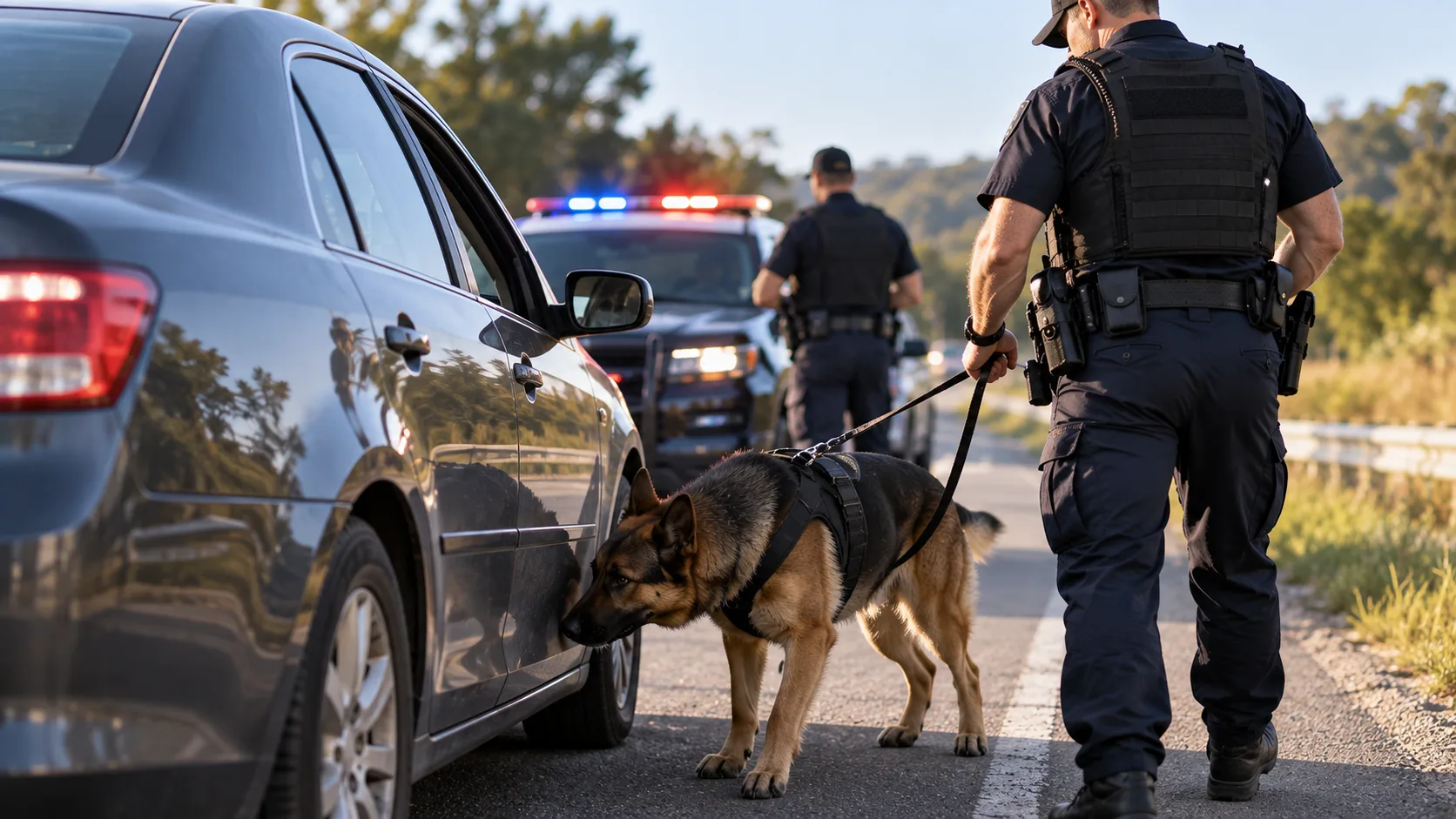
Sometimes, but not simply because an officer wants extra time for a drug dog to arrive. The key question is whether the K9 activity adds time to the traffic stop and, if so, whether police have an independent legal reason for that added detention.
The leading case isRodriguez v. United States. In that case, the officer had completed the tasks connected with the traffic violation and issued a written warning. The officer then continued to detain the driver for roughly seven or eight additional minutes until a second officer arrived and a police dog walked around the vehicle.
The Supreme Court held that a traffic stop may not be prolonged beyond the time reasonably required to complete its traffic-related mission merely to conduct a dog sniff. The Court rejected the idea that a brief additional delay is automatically acceptable just because it lasts only a few minutes.
That does not mean every K9 sniff during a traffic stop is unlawful. Timing and justification matter.
A K9 sniff can occur while the lawful traffic stop is still underway
Ten years before Rodriguez, the Supreme Court decidedIllinois v. Caballes. There, one state trooper was processing a speeding stop when another trooper arrived with a drug-detection dog. The dog walked around the vehicle while the first officer was still writing the warning.
The entire encounter lasted less than ten minutes, and the Court concluded that the dog sniff conducted during the lawful traffic stop did not itself violate the Fourth Amendment.
Caballes therefore does not stand for the rule that police can always hold a driver until a K9 arrives. It involved a sniff that occurred while the original traffic stop was still being completed.
Rodriguez later made the distinction clearer: an officer cannot add time to the stop for a dog sniff when the dog activity is not part of the traffic mission, unless another lawful basis supports the continued detention.
When waiting for the K9 becomes a constitutional issue
Rodriguez involved a driver stopped after an officer observed the vehicle briefly travel onto the highway shoulder. The officer checked the driver's documents, questioned the occupants, ran records checks, and eventually issued a warning.
After those traffic tasks were completed, the officer asked for permission to walk his dog around the vehicle. The driver refused. The officer then detained the occupants until another officer arrived, after which the dog sniff was performed.
The Supreme Court ruled that the Fourth Amendment does not permit police to extend an otherwise completed traffic stop for that unrelated dog investigation without an independent legal justification.
Importantly, the Court did not create a grace period. The issue was not whether seven or eight minutes felt short. The issue was whether the detention had been prolonged beyond the traffic mission for a different investigative purpose.
What counts as the traffic-stop mission?
Rodriguez describes the ordinary mission of a traffic stop as addressing the traffic violation that warranted the stop and handling related safety concerns.
Typical traffic-related tasks can include checking a driver's license, determining whether there are outstanding warrants, checking registration and insurance information where applicable, and preparing a citation or warning.
The Court treated those activities differently from a drug-detection dog sniff. A K9 sniff for narcotics is aimed at detecting evidence of ordinary criminal wrongdoing rather than completing the traffic violation investigation.
That distinction is why the question is not simply, “Was I still standing on the roadside?” The more useful question is what officers were still doing and why the stop had not yet ended.
Our broaderTraffic Stop Rights guideexplains why stop duration, document checks, questioning, search requests, and officer-safety measures should be recorded separately.
What if police develop reasonable suspicion of another crime?
Rodriguez does not say that police must release a person immediately after the traffic tasks are complete regardless of everything officers have learned during the encounter.
If officers develop a separate lawful basis to continue the detention, such as reasonable suspicion of additional criminal activity, the analysis can change.
Reasonable suspicion is more than an unsupported hunch. Whether particular observations amount to reasonable suspicion is highly fact-specific and can depend on the total circumstances known to the officers.
A general article cannot decide whether the facts of one stop met that standard. If a K9 delay later becomes important in court, the timeline and the reasons officers documented for extending the stop can be central.
Do not assume that asking for a K9 automatically proves reasonable suspicion. Likewise, do not assume that the absence of a traffic ticket automatically proves there was no separate basis to investigate another offense.
There is no nationwide “10-minute” or “20-minute” K9 rule
Searches online often ask how many minutes police are allowed to make someone wait for a dog. The Supreme Court has not established a universal stopwatch rule.
Rodriguez specifically rejected the idea that a short extension can be justified merely because it is only a minor or “de minimis” delay. The constitutional question focuses on whether the stop was prolonged for an unrelated investigation without independent justification.
At the same time, an ordinary traffic stop can legitimately take different amounts of time depending on the circumstances. Document checks, roadside safety, computer systems, multiple occupants, citation preparation, or other traffic-related tasks can affect duration.
That is why “I waited 18 minutes” does not answer the legal question by itself. A useful timeline identifies what happened during those 18 minutes.
Refusing consent and waiting for a K9 are separate issues
A driver can decline a request for consent to search. A clear statement such as “I do not consent to a search” preserves the fact that permission was not voluntarily given.
Refusing consent does not automatically require police to end every investigation, but it also does not itself create reasonable suspicion or give police unlimited time to hold the vehicle until a dog arrives.
Rodriguez is especially relevant because the driver refused permission for the dog sniff and the officer continued the detention. The Supreme Court still required a lawful justification for the added time.
For the broader difference between consent and other claimed search authority, readCan Police Search Your Car, Phone, or Home Without Consent?.
What happens if the police dog alerts on the vehicle?
A dog alert raises a different legal question from whether officers were allowed to prolong the stop until the sniff occurred.
Caballes involved a trained dog that alerted at the vehicle's trunk while the speeding stop was still underway. The officers then searched the trunk and found marijuana.
The legality and reliability of a particular canine alert can involve facts about the dog, training, certification, handling, and circumstances of the sniff. Those issues are separate from the Rodriguez timing question.
In other words, a later alert does not retroactively answer whether the earlier detention used to obtain that alert was lawful. Courts can examine the sequence step by step.
What should you document after a K9 traffic stop?
If the length of the detention may matter, make a timeline as soon as it is safe.
Record the approximate time the vehicle stopped, when documents were requested, when they were returned, whether a citation or warning was issued, when the K9 was first mentioned, when consent was requested, whether you refused consent, when the dog arrived, when the sniff occurred, and when you were released or arrested.
Also preserve citations, warnings, tow records, property receipts, original video, and any other paperwork. If body-camera or dash-camera evidence may matter, local retention periods can be important.
Do not physically interfere with a dog sniff or attempt to leave simply because you believe the traffic mission is complete. A court or local attorney can evaluate the detention afterward using the actual record.
What to do next
The basic distinction is straightforward: Caballes permits a dog sniff that occurs during an otherwise lawful traffic stop without unlawfully adding time, while Rodriguez says police cannot prolong the stop for a dog sniff after the traffic mission should be complete without a separate lawful justification.
For general roadside rules, use theTraffic Stop Rights guide. For vehicle-search questions, use thePolice Search Consent guide. For a quick scenario reference, useWhat to Do If Police Stop You.
This page provides general federal constitutional background. State law and the facts of an individual detention can add other issues. A licensed attorney in the relevant jurisdiction can review a particular K9 stop.
Frequently asked questions
Can police make you wait for a K9 during a traffic stop?
Police cannot prolong a traffic stop beyond the time reasonably needed to complete the traffic mission solely to conduct a dog sniff unless there is a separate lawful justification, such as reasonable suspicion of criminal activity. Rodriguez v. United States is the leading Supreme Court case.
Can a K9 sniff happen while the officer is writing the ticket?
Yes, it can. Illinois v. Caballes held that a dog sniff conducted during an otherwise lawful traffic stop did not violate the Fourth Amendment where it did not unlawfully prolong the stop.
How long can police make you wait for a police dog?
The Supreme Court has not created a nationwide number of minutes. The important question is whether the dog sniff added time beyond the traffic mission and, if it did, whether police had an independent lawful basis for the additional detention.
Does refusing consent let police hold you until a K9 arrives?
Refusing consent does not by itself create authority to prolong a completed traffic stop. Police may rely on another lawful basis if one exists, but consent and the legal justification for continued detention are separate questions.
Sources and verification
Use the linked source for its stated jurisdiction. Requirements and procedures can change; check the current agency notice before acting.
- U.S. Supreme Court: Rodriguez v. United States — extending a traffic stop for a dog sniff checked
- U.S. Supreme Court: Illinois v. Caballes — dog sniff during an ongoing lawful traffic stop checked
- U.S. Courts: What Does the Fourth Amendment Mean? checked
Found an error? Send the page URL and a supporting source to[email protected].