Police encounters · Traffic-stop procedures
Why Do Police Shine a Flashlight Inside Your Car?
Police use flashlights during nighttime traffic stops for visibility and safety. Learn what officers look for and what Texas v. Brown says about illuminating a car.
Independent educational reference. Not a police agency, hiring decision, or legal opinion.How we use sources.
Why do police shine a flashlight inside your car?
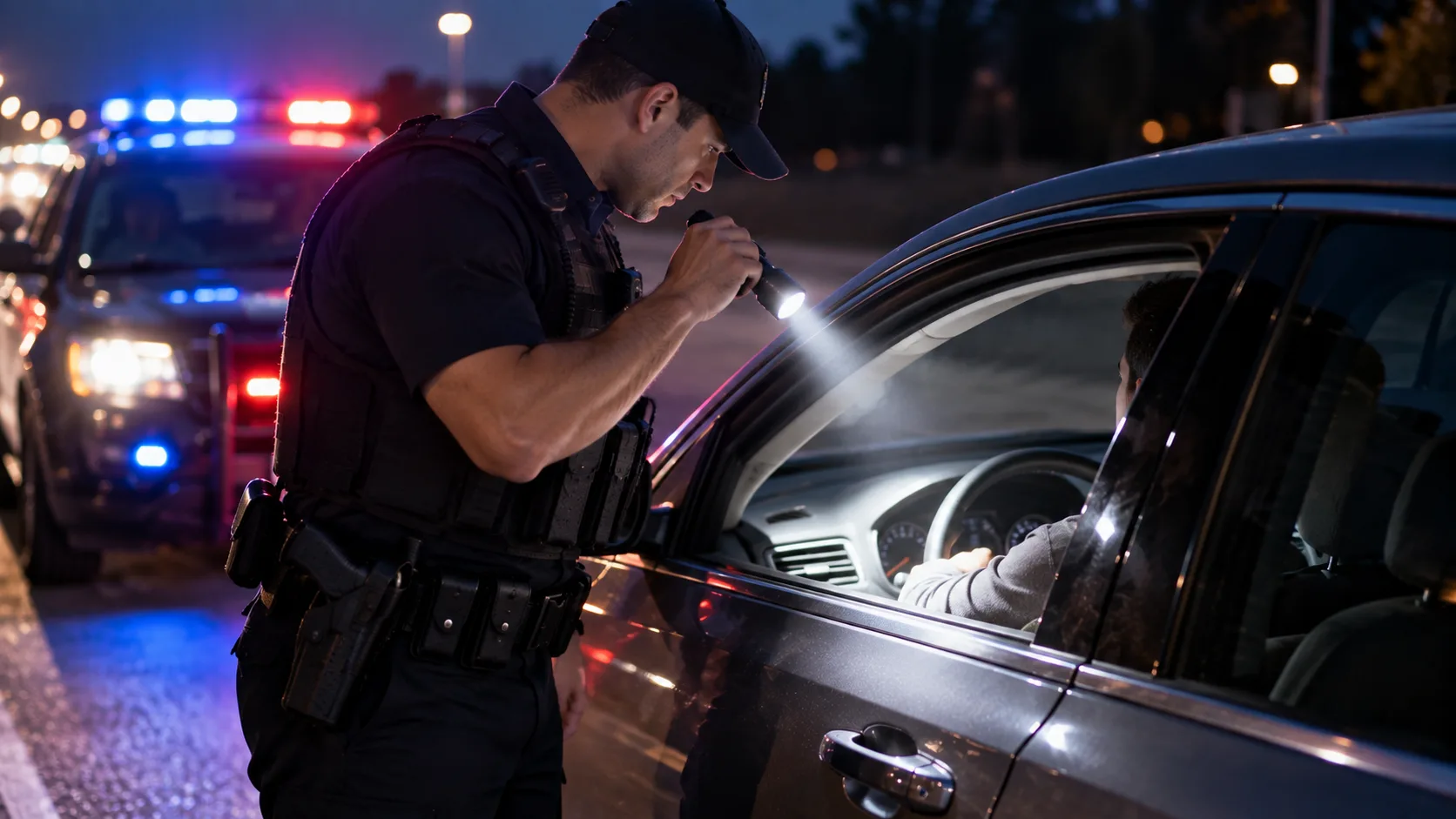
The simplest reason is visibility. A nighttime traffic stop places an officer beside an unfamiliar vehicle with one or more occupants, often on the side of an active roadway. The officer needs to see who is inside, where hands are located, whether anyone is moving, and what is happening before standing close to an open window.
Official police training materials treat the flashlight as part of nighttime vehicle-stop tactics. TheCalifornia POST vehicle-pullover workbookinstructs officers to continuously observe occupants during the approach and discusses tactical flashlight use at night.
Florida's current basic recruit training likewise tells officers that, during a nighttime driver-side approach, the flashlight should be held in the support hand. Its training also teaches officers to examine the passenger compartment and watch the occupants' hands and movements.
So when an officer shines a light across the front seats or floor area, it does not automatically mean the officer believes the driver has committed another crime. It can be part of routine nighttime observation.
Flashlights help officers manage a low-light roadside environment
Darkness changes an ordinary vehicle stop. The driver can usually see the patrol vehicle's emergency lights, but the officer may have difficulty seeing inside a dark passenger compartment.
Interior lights may be off, windows may be tinted, clothing and objects can blend into shadows, and movement can be difficult to interpret from outside.
A flashlight lets the officer direct light where it is needed without depending on streetlights or the patrol vehicle's headlights.
California POST also warns officers to use a flashlight tactically during the approach so that vehicle occupants cannot easily track the officer's movement before contact. Florida training similarly recommends keeping the flashlight off during part of the approach and using it once contact is made.
That shows two different functions of the tool: first, avoiding unnecessarily revealing the officer's exact position during the approach; second, improving visibility once the officer reaches the vehicle.
Why are officers especially interested in hands and movement?
Police vehicle-stop training places significant emphasis on observing hands.
Hands can reveal what an occupant is doing, whether the person is retrieving requested documents, whether an object is being moved, or whether someone is reaching into an area the officer cannot clearly see.
Florida training tells officers to observe driver hand position and watch for movement toward the floorboard, back seat, glove compartment, center console, or other areas.
A flashlight makes those observations easier at night.
This is one reason drivers are often advised to keep their hands visible and avoid unexpectedly reaching around the vehicle. If registration is in the glove compartment, for example, tell the officer where it is before reaching toward it.
That does not mean reaching for your registration is unlawful or automatically suspicious. It means the officer may not know what you are reaching for until you explain it.
What can an officer observe inside the car?
From a lawful position outside the vehicle, an officer can generally observe areas of the passenger compartment that are exposed to view through the windows.
That can include the seats, floorboard, dashboard, center console, occupants, open containers, or objects lying in visible areas.
An officer may change position to obtain a better viewing angle. InTexas v. Brown, the officer shifted position and bent down to see inside a vehicle and an open glove compartment.
The Supreme Court said that observation from those lawful outside positions did not violate a reasonable expectation of privacy because the visible portions of the vehicle interior could also be seen by members of the public from outside.
That principle is different from physically entering the vehicle or opening something that is closed. Seeing an object and searching for an object are not always the same legal act.
Texas v. Brown directly addressed the use of a flashlight
Texas v. Brown is especially relevant because the officer actually used a flashlight during a nighttime vehicle stop.
The officer stopped Brown at a driver's-license checkpoint and shined a flashlight into the car while asking for his license. The officer saw Brown holding an opaque balloon that, based on the officer's narcotics experience, appeared significant. Brown then opened the glove compartment while searching for his license, allowing the officer to see additional items.
When the case reached the Supreme Court, the Court said there was no constitutional problem with using the flashlight to illuminate the vehicle interior.
The Court relied in part on an earlier Supreme Court observation that using artificial light to illuminate what could otherwise be seen does not, by itself, transform the observation into a Fourth Amendment search.
That rule is useful because it separates illumination from a more intrusive police action.
Why is shining a flashlight not automatically considered a search?
The Fourth Amendment generally protects reasonable expectations of privacy against unreasonable searches and seizures.
A vehicle has privacy protection, but not everything visible through its windows is hidden from public observation.
In Brown, the Supreme Court explained that the officer did not gain access to a constitutionally protected area merely by adding artificial light. The flashlight improved the officer's ability to see an area already exposed to observation from outside.
The same basic distinction can apply when daylight, a streetlight, headlights, or another ordinary source of illumination makes something visible.
That does not mean every use of technology to see something hidden is constitutionally identical to an ordinary flashlight. Different surveillance technologies can raise different Fourth Amendment issues.
This page is limited to ordinary flashlight illumination during a vehicle stop.
What does the flashlight not authorize police to do?
A flashlight is not a general search warrant.
The ability to illuminate the visible interior does not automatically authorize an officer to open the door, enter the vehicle, move clothing or bags, open a closed glove compartment, search a console, unlock a phone, or inspect a closed container.
Those actions can require a separate legal basis depending on the circumstances.
TheU.S. Courts Fourth Amendment overviewexplains the broader warrant requirement and recognized exceptions.
If police ask for permission to search, consent is a separate issue. You can state that you do not consent without physically interfering.
OurPolice Search Consent guideexplains why consent, a warrant, probable cause, officer-safety measures, and other claimed search authority should remain separate in your notes.
What should the driver do when an officer shines a flashlight inside?
You usually do not need to react to the flashlight itself.
Keep your hands visible and avoid sudden movements. If the light is pointed through the driver's window, continue listening to the officer's instructions rather than trying to block the beam or move objects out of view.
If asked for a driver's license, registration, or insurance information, explain where the item is before reaching for it.
At night, turning on the vehicle's interior light after stopping can improve visibility and reduce uncertainty, although it does not replace the officer's own lighting and observation tactics.
Do not assume the officer's flashlight means you have been accused of possessing drugs or a weapon. Wait for the officer to explain any additional investigation or instruction.
What should passengers expect?
The beam may move across the passenger seat, rear seat, floorboards, or occupants because officers are trying to understand who is inside the vehicle and what everyone is doing.
Passengers should avoid sudden reaching into bags, under seats, or toward the center console while the officer is observing the vehicle.
If the officer approaches from the passenger side, the flashlight may be particularly noticeable because the officer is standing closer to the passenger than the driver.
Ourpassenger-side approach guideexplains the roadway-safety and observation reasons behind that tactic.
Passenger identification is another separate issue. ReadDoes a Passenger Have to Show ID During a Traffic Stop?for that question.
What to do next
During a nighttime traffic stop, a flashlight is primarily a visibility and safety tool. It helps officers observe occupants, hands, movement, vehicle areas visible from outside, and possible hazards.
Texas v. Brown establishes an important federal baseline: merely illuminating the visible interior of a vehicle with a flashlight from a lawful position outside is not itself a Fourth Amendment search.
That rule should not be stretched into a claim that police may conduct any further search they want. Observation, seizure, entry, and a physical search are distinct legal questions.
For the wider encounter, readWhat Are My Rights During a Traffic Stop?. For vehicle-search questions, usePolice Search Consent. For quick roadside guidance, useWhat to Do If Police Stop You.
Frequently asked questions
Why do police shine a flashlight inside your car during a traffic stop?
At night, officers use flashlights to see occupants, hands, movement, the vehicle interior, and possible hazards. Official traffic-stop training treats the flashlight as an observation and officer-safety tool.
Is it legal for police to shine a flashlight into your car?
As a general federal Fourth Amendment rule, illuminating the visible interior of a lawfully stopped vehicle from outside is not itself a search. In Texas v. Brown, the U.S. Supreme Court said the officer’s use of a flashlight to illuminate the vehicle interior violated no Fourth Amendment right.
Can police use a flashlight to look through the windows?
Police can generally observe what is visible from a lawful outside position, including with ordinary artificial illumination. That does not automatically authorize opening containers, entering the vehicle, moving objects, or conducting a broader search.
Does a flashlight mean the officer suspects drugs or a weapon?
Not necessarily. Flashlights are commonly used during nighttime stops for visibility and safety. What an officer later observes can affect the encounter, but the use of the flashlight alone does not prove a particular suspicion.
Sources and verification
Use the linked source for its stated jurisdiction. Requirements and procedures can change; check the current agency notice before acting.
- U.S. Supreme Court: Texas v. Brown — flashlight illumination and plain view checked
- California POST: LD 22 — Vehicle Pullovers checked
- California POST: Current Basic Course Student Workbooks checked
- Florida Department of Law Enforcement: 2025 Law Enforcement Auxiliary Academy Text checked
- U.S. Courts: What Does the Fourth Amendment Mean? checked
Found an error? Send the page URL and a supporting source to[email protected].