Police encounters · Traffic-stop procedures
Why Do Police Touch the Back of Your Car During a Traffic Stop?
Learn why some officers touch a car’s trunk or rear during a traffic stop, what official police training says about safety and fingerprints, and why the practice varies.
Independent educational reference. Not a police agency, hiring decision, or legal opinion.How we use sources.
Why do police sometimes touch the back of a car?
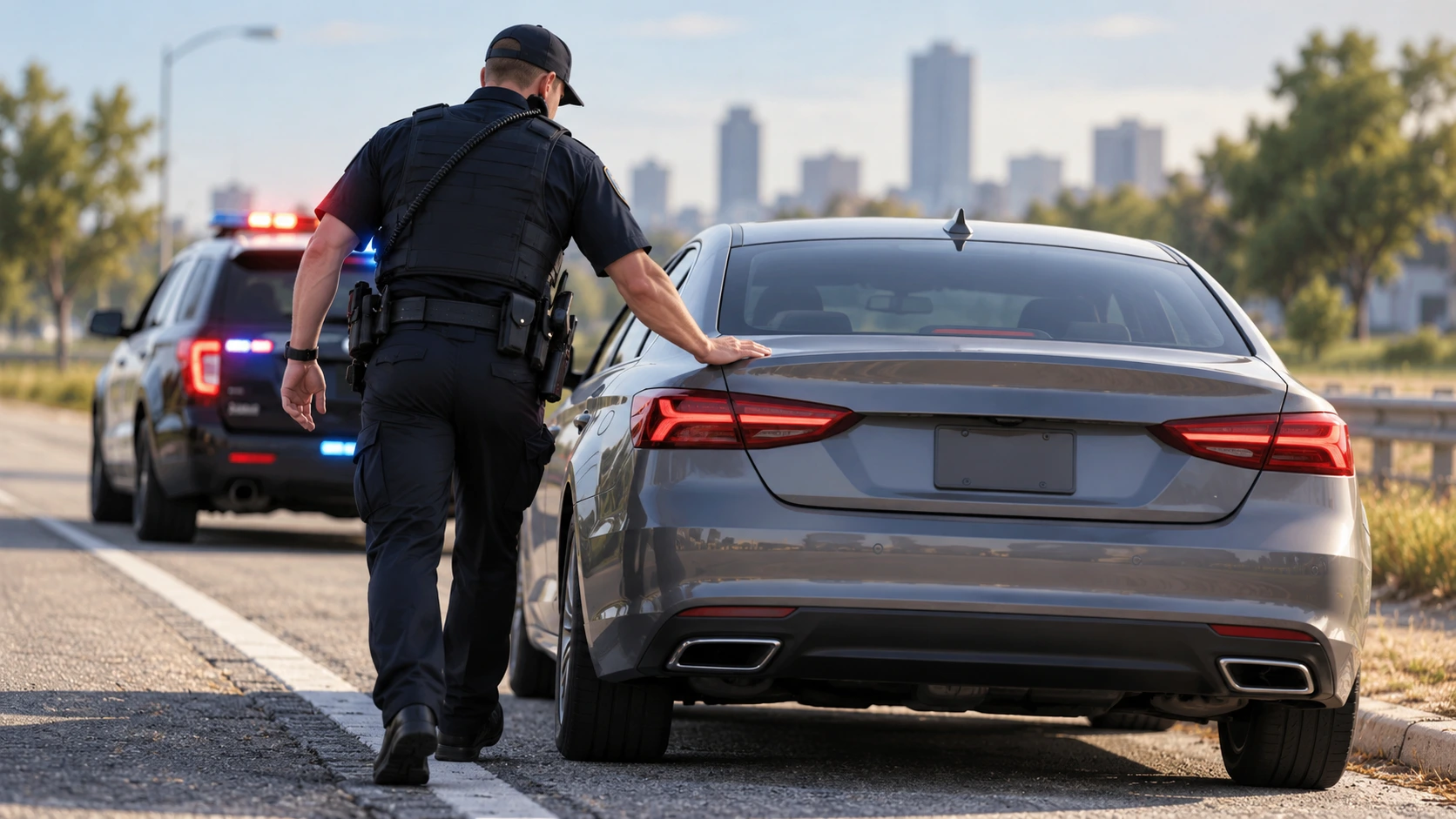
If you have watched an officer walk toward a vehicle during a traffic stop, you may have noticed a quick hand movement near the trunk, rear hatch, or another part of the back of the vehicle. Online explanations often reduce that movement to one dramatic story: the officer is supposedly placing a fingerprint on the taillight in case something happens during the stop. There is some real training history behind the fingerprint explanation, but it is incomplete when presented as the universal reason.
The clearest example comes from theFlorida Department of Law Enforcement training textbook. Its traffic-stop material instructs recruits to examine the rear of the vehicle and describes touching the trunk lid. The same material specifically identifies both trunk security and the transfer of the officer’s fingerprints to the vehicle as reasons for rear-vehicle contact.
Other state training materials emphasize the safety check. TheCalifornia Commission on Peace Officer Standards and Training vehicle-pullover workbooksays officers approaching a target vehicle on foot may check the exterior of the trunk visually and by hand. It notes that an open or unsecured trunk, or a trunk with a damaged lock, can cause an officer to reassess the situation and consider additional precautions.
These examples are important because they provide a better answer than repeating a social-media explanation. The touch can be part of an officer-safety and vehicle-assessment routine, and some official training has also treated the resulting fingerprint as evidence of contact.
The trunk-safety reason
A police officer approaching a stopped car does not begin evaluating the vehicle only when they reach the driver’s window. Vehicle-approach training teaches officers to observe the car and its occupants while moving toward it. That can include the vehicle’s rear, windows, trunk, occupants, roadway position, and other visible conditions.
California POST’sBasic Tactical Considerations for Vehicle Pulloversspecifically describes an exterior trunk check. An open or unsecured trunk can change the officer’s assessment of the approach. That is more precise than saying officers touch cars because they automatically believe someone is hiding inside every trunk.
Ohio provides another official example. Material from theOhio Peace Officer Training Commissionincludes touching the trunk to guard against an unexpected opening during a vehicle-approach procedure. The context matters: a training step designed around officer safety should not automatically be interpreted by a driver as an accusation that the driver committed another crime.
More broadly, theU.S. Department of Justice Office of Justice Programshas published law-enforcement training literature emphasizing the uncertainty and safety risks officers manage during traffic stops. Agencies may address those risks using different positioning, lighting, observation, communication, backup, and approach techniques.
Why would an officer want to leave fingerprints on the vehicle?
The fingerprint explanation is not simply an internet invention. Florida’s official training material expressly says that touching the rear of the driver’s vehicle transfers the officer’s fingerprints and creates evidence of contact with that vehicle. That gives the familiar explanation a documented training source.
The careful way to describe it, however, is that some training has taught this reason. It would be inaccurate to jump from a Florida training instruction to the claim that every officer in the United States touches every stopped car primarily to leave fingerprints.
Police agencies operate under different state standards, local policies, academy curricula, field-training programs, and tactical practices. Even the official state examples used in this guide describe rear-vehicle contact differently. Florida explicitly discusses fingerprints, California focuses on visual and hand examination of the trunk exterior, and Ohio includes a trunk touch in an officer-safety approach procedure.
That difference is useful for understanding police procedures generally: seeing an officer perform one action does not tell you which academy lesson, department policy, or tactical judgment produced it. If the exact policy matters in a particular incident, the relevant source is the officer’s agency and the training or policy applicable at that time.
Why is the practice often called a “taillight tap”?
Searches for this question frequently use phrases such as “why do cops touch your taillight,” “why do cops tap the back of your car,” or “why do police touch your trunk.” Those phrases describe roughly the same visible behavior, but the official materials reviewed here more often describe the rear of the vehicle or trunk rather than establishing a special nationwide rule about one specific taillight.
That distinction matters. A driver may see an officer place a hand near a taillight because that is where the officer’s hand happens to contact the rear of the car. Another officer may touch the trunk lid or rear hatch. Another may conduct the approach without making the same contact.
So “taillight tap” is a convenient search phrase, not a precise description of a nationally standardized police procedure.
Is touching the car required on every traffic stop?
The sources reviewed for this page do not establish one national requirement that every U.S. police officer must touch the rear of every stopped vehicle. They are examples of state training materials, and their instructions are not identical.
Florida’s training material describes rear-vehicle contact directly. California POST says officers may check the exterior of the trunk visually and by hand. Ohio’s cited material discusses a trunk touch in a particular vehicle-approach sequence. Those differences are exactly why a state or academy example should not be presented as a universal federal rule.
The circumstances also affect how an officer approaches a vehicle. Roadway traffic, lighting, vehicle type, number and location of occupants, information received before the stop, visibility, backup, and the nature of the stop can all affect tactical choices. A routine roadside contact and a high-risk vehicle stop are not necessarily conducted in the same manner.
If you are researching a specific department rather than the general question, look for that agency’s current traffic-stop, vehicle-approach, body-camera, or field-training materials. Do not assume a training manual from another state controls the department involved in your situation.
What else is an officer doing while approaching the vehicle?
The rear touch is only a small part of a larger vehicle approach. Florida’s training material instructs officers to continue observing the vehicle and occupants during the approach. California POST likewise describes observation beginning before the officer reaches the vehicle and continuing through the pullover.
Officers may be evaluating where they can safely stand, passing traffic, visibility into the vehicle, occupant movement, the condition of the trunk or rear of the car, and the safest side from which to approach. That helps explain why an officer may not immediately walk straight to the driver’s window after the vehicle stops.
It also explains why two traffic stops can look different without either automatically being unusual. An officer can choose a driver-side approach, passenger-side approach, different position, or additional precautions according to training and the conditions present.
For the driver, those tactical choices generally do not change the basic practical goal: make the stop predictable and avoid sudden movements while the officer approaches.
What should you do if an officer touches the back of your car?
Usually, nothing special is required from the driver merely because an officer touched the rear of the vehicle. The better focus is the traffic stop itself. Pull over in a safe location when directed, remain calm, keep movements visible, and avoid unexpectedly reaching into a console, pocket, bag, or glove compartment while an officer is approaching.
If you need to retrieve a driver’s license, registration, insurance card, or another requested item, tell the officer where the item is before reaching for it. TheAll Police Guide traffic-stop rights guideexplains the separate issues of driver documents, questioning, stop duration, passengers, searches, and what information to preserve afterward.
A touch on the rear of the vehicle does not by itself answer any of those legal questions. It does not tell you whether a search will occur, whether you are suspected of another offense, how long the stop may last, or whether the officer will issue a warning or citation.
What the touch does not necessarily mean
Do not assume that the officer has discovered contraband, believes the car is stolen, or is about to arrest someone merely because you noticed contact with the rear of the vehicle. Official training materials show that rear or trunk checks can be taught as part of the approach itself.
At the same time, do not use a general article to decide the meaning of a particular officer’s actions. If an actual stop later becomes relevant to a citation, arrest, search, complaint, or court case, preserve the specific facts: time, place, agency, instructions, questions, documents, search requests, property receipts, citation, and available original video.
If your question is specifically about whether officers could search the vehicle rather than why they touched its exterior, readCan Police Search Your Car, Phone, or Home Without Consent?Search authority, consent, warrants, vehicle exceptions, and a routine approach tactic are separate issues and should not be collapsed into one rule.
What to do next
If you came here after seeing the technique in a video or during your own traffic stop, the short answer is now clearer: there is documented police-training support for both the trunk-safety explanation and the fingerprint explanation, but the technique is not best described as one universal U.S. rule.
For the broader encounter, continue withWhat Are My Rights During a Traffic Stop?. If your question concerns identification rules rather than the vehicle approach itself, use theStop and Identify Laws by Statereference. For a short driving-versus-walking comparison, open thepolice-stop rights reference.
All Police Guide is an independent educational resource. The training documents linked above illustrate particular official programs and should be read for their stated jurisdiction and date. They do not establish the current policy of every U.S. police agency.
Another approach tactic is choosing the opposite side of the vehicle. Read why officers sometimes approach from the passenger side for the roadway-safety and observation reasons behind that technique.
Frequently asked questions
Why do police touch the back of your car when they pull you over?
Some police training materials teach officers to check the rear or trunk as part of a vehicle approach. Florida training material also says contact with the rear can leave the officer’s fingerprints as evidence of contact. Practices differ by agency, training program, stop type, and circumstances.
Do police touch the taillight to leave fingerprints?
That explanation is supported by at least one official state training source. Florida law-enforcement training material says touching the rear of the vehicle transfers the officer’s fingerprints and provides evidence of contact. That does not mean fingerprinting is the reason for every officer’s touch in every jurisdiction.
Are police checking whether someone is hiding in the trunk?
Officer-safety training materials do teach officers to assess whether a trunk is open or unsecured. California POST says officers approaching a vehicle may check the exterior of the trunk visually and by hand, while Ohio training material describes touching the trunk to guard against unexpected opening.
Does every police officer touch the back of every car?
No nationwide rule is established by the state training materials reviewed for this guide. Florida, California, and Ohio describe the technique differently and in different contexts. An officer’s actual approach depends on agency training, policy, stop type, roadway conditions, and the circumstances encountered.
Sources and verification
Use the linked source for its stated jurisdiction. Requirements and procedures can change; check the current agency notice before acting.
- Florida Department of Law Enforcement: 2023 Law Enforcement Auxiliary Basic Recruit Training Program — traffic stops checked
- California POST: LD 22 — Vehicle Pullovers checked
- Ohio Attorney General / Ohio Peace Officer Training Commission: Stops & Approaches checked
- Office of Justice Programs: Traffic Stops — Surviving Interactions with the Motoring Public checked
Found an error? Send the page URL and a supporting source to[email protected].