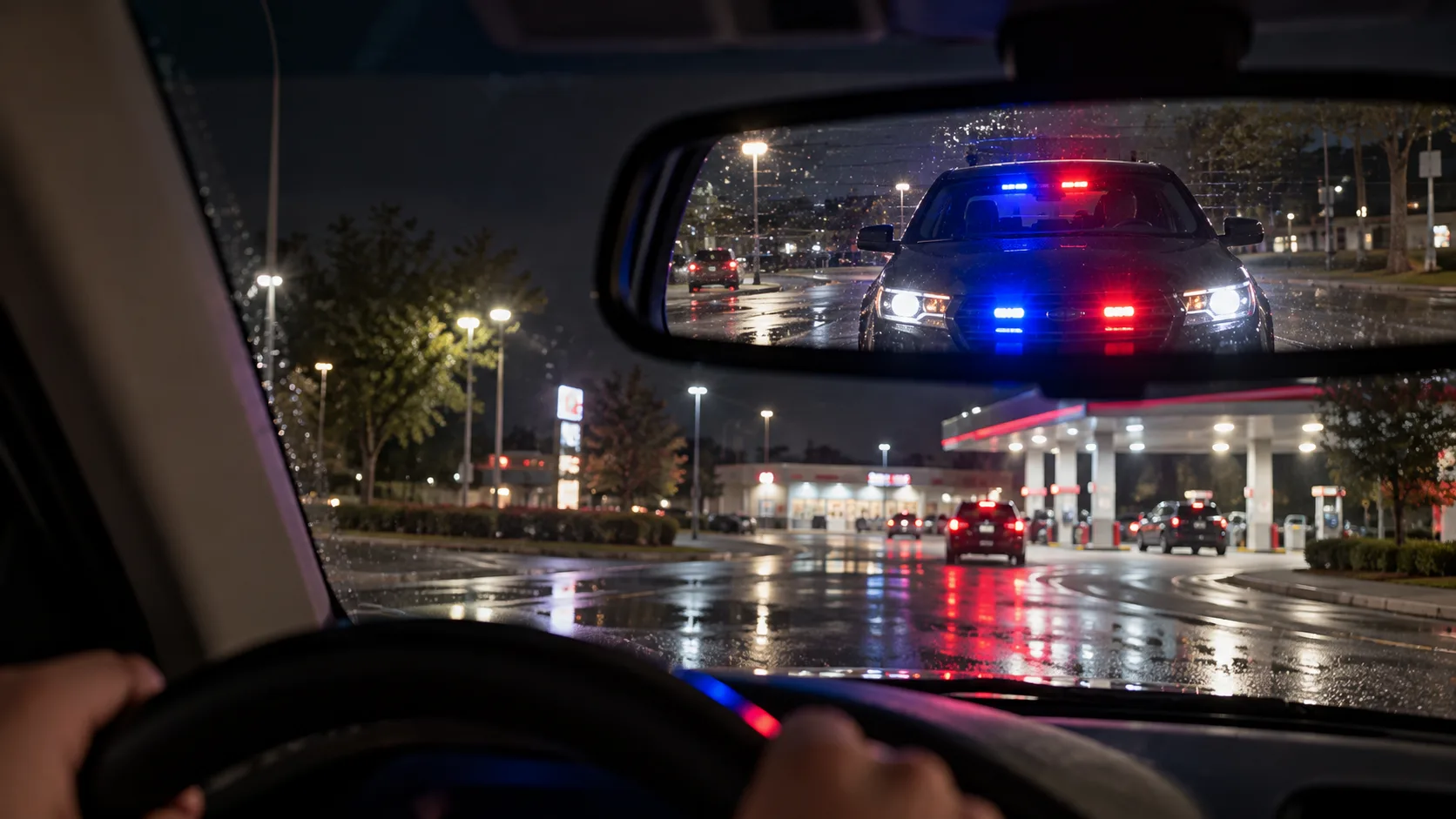
Police encounters · Unmarked vehicle stops
Can an Unmarked Police Car Pull You Over?
Yes, unmarked police vehicles can conduct traffic stops in many states. Learn why state rules differ and what to do if you are unsure the vehicle is legitimate.
Independent educational reference. Not a police agency, hiring decision, or legal opinion.How we use sources.
Can an unmarked police car pull you over?
Yes, in many parts of the United States.
An unmarked vehicle does not automatically mean the person driving it lacks police authority. State police agencies, sheriff's offices, municipal departments, investigators, and traffic units can operate vehicles that do not carry the exterior graphics drivers associate with a traditional patrol car.
Pennsylvania's officialdriver manualexpressly warns motorists that, in some cases, an unmarked police vehicle may signal a traffic stop.
New York State Police provides an even clearer enforcement example. ItsConcealed Identity Traffic Enforcement programuses unmarked vehicles that blend into ordinary traffic so troopers can detect violations before activating emergency lighting.
The important qualification is jurisdiction. A vehicle lawful for traffic enforcement in one state may be subject to different marking or operational rules in another.
Why do state rules matter?
Vehicle markings are generally governed by state statutes, agency rules, and local policy rather than one national police-car standard.
Some states expressly authorize law-enforcement exceptions to ordinary government-vehicle marking requirements. Others place limits on which unmarked vehicles can perform routine traffic enforcement.
That means two different questions must remain separate:
- Does the officer have legal authority to stop the vehicle?
- Does the police vehicle comply with the state's marking and equipment rules?
Those questions often overlap, but they are not identical.
If a state restricts the use of unmarked vehicles, that does not justify a driver making an immediate roadside legal conclusion and fleeing. The safer approach is to comply while preserving the facts for later review.
New York openly uses unmarked vehicles for traffic enforcement
New York State Police describes its Concealed Identity Traffic Enforcement vehicles as unmarked vehicles designed to blend into everyday traffic.
The agency says the vehicles are used to identify drivers committing violations such as speeding, aggressive driving, distracted driving, and seat-belt offenses.
Once emergency lighting is activated, State Police describes the vehicles as recognizable emergency vehicles.
This is useful evidence against the widespread claim that an unmarked police vehicle can never make a traffic stop.
It also shows why appearance alone is not enough. Before activation, an enforcement vehicle may look similar to an ordinary passenger car or SUV.
Washington shows how marking exceptions can be written into state law
Washington'sRCW 46.08.065contains government-vehicle marking requirements and several law-enforcement exceptions.
The statute exempts vehicles used by Washington State Patrol for general undercover or confidential investigative purposes from certain state vehicle-marking requirements.
It also allows the Washington State Patrol chief discretion to exempt traffic-control vehicles from specified marking requirements.
The statute is a good example of why a national yes-or-no statement about unmarked police cars can be misleading. The legal answer may depend on the type of police unit, the purpose of the vehicle, and a state-specific exception.
An article about another state should therefore use that state's law rather than copying Washington's rule.
How does an unmarked police car signal you to stop?
Unmarked vehicles can have emergency equipment that is concealed until activated.
New York State Police says its CITE vehicles blend into ordinary traffic but become recognizable as emergency vehicles when their emergency lighting is turned on.
Pennsylvania's official driver manual similarly notes that an unmarked police vehicle may use emergency lighting during a stop.
Lighting configurations vary by state and vehicle. Lights can be mounted in a grille, windshield, rear window, visor area, or another authorized location rather than on a traditional roof light bar.
The vehicle may also have a siren.
Do not assume that the absence of rooftop lights means the vehicle cannot be a real police unit.
What should you do if you are not sure the vehicle is really police?
Police impersonation is a legitimate safety concern, and official agencies have published guidance for drivers who are genuinely uncertain.
TheOneida County Sheriff's Officeadvises drivers who doubt an unmarked vehicle to acknowledge the attempted stop, move toward a lighted or busy area, and call 911 to explain that an unmarked vehicle is attempting to stop them.
The sheriff recommends giving dispatch the location and a description of the vehicle and, if possible, its plate information.
The key is to make your behavior look like verification and safe compliance—not escape.
Turn on your hazard lights or turn signal to show that you have seen the emergency lights. Reduce speed. Do not accelerate away or begin driving unpredictably.
When calling 911, explain that you are being signaled to stop by an unmarked vehicle and want to verify whether it is a legitimate law-enforcement unit.
Can you drive to a safer location before stopping?
Some official police guidance recommends moving to a nearby well-lit or populated location when a driver genuinely doubts an unmarked vehicle or the immediate roadside location is unsafe.
Oneida County advises motorists to signal that they acknowledge the stop and proceed to a lighted or busy area rather than speeding away.
This should not be treated as permission to continue driving for an unlimited distance.
The purpose is to make a short, obvious move toward a safer stopping place while clearly showing that you are responding to the officer.
California DMV'slaw-enforcement stop guidancelikewise tells drivers to acknowledge an officer with the turn signal, move to the right shoulder, and stop in a well-lit area when possible.
State laws concerning failure to stop or fleeing can be serious, so do not turn verification into a pursuit.
What if the officer gets out wearing plain clothes?
Unmarked vehicle and plainclothes officer are separate facts, but they can occur together.
If you have a genuine identity concern after stopping, Oneida County's guidance says you can ask to see police identification containing the officer's name, photograph, and agency.
Keep the vehicle doors locked while you verify the situation if you are genuinely uncertain, and communicate through a partially opened window rather than abruptly exiting the car.
If dispatch confirms that the person is an officer, follow lawful instructions.
Do not turn an identification request into physical resistance or an attempt to leave once the stop has been verified.
Why you should not simply refuse to stop
An unmarked car may still be an authorized police vehicle.
Driving away at high speed because the vehicle lacks external graphics can be interpreted very differently from slowing down, activating hazard lights, calling dispatch, and proceeding a short distance to a safe location.
Oneida County specifically advises drivers not to drive away at high speed because officers may believe the driver is attempting to escape.
Pennsylvania's driver manual tells motorists stopped by police to follow the officer's directions during the stop.
If you believe the officer or vehicle violated state rules, preserve that issue for later review rather than trying to decide it during a moving roadside encounter.
What should you document after an unusual unmarked-car stop?
Write down the agency, date, time, road, direction of travel, vehicle description, emergency-light configuration, and any identifying information you safely observed.
Record whether you called 911 or another dispatch center, what the dispatcher told you, whether the officer was uniformed or in plain clothes, and whether another marked unit arrived.
Also preserve the citation, warning, officer business card, dash-camera recording, phone call log, or other documents.
If the issue later concerns whether the unmarked unit complied with state vehicle-marking requirements, locate the actual state statute and agency policy rather than relying on a national internet list.
A vehicle-marking violation, where one exists, also should not automatically be treated as proof that every later police action was invalid. Those legal consequences depend on the jurisdiction and circumstances.
What to do next
The short answer is that unmarked police vehicles can and do conduct traffic enforcement in many jurisdictions. New York State Police openly uses concealed-identity vehicles for traffic enforcement, Pennsylvania's driver manual anticipates stops by unmarked police vehicles, and Washington law contains express law-enforcement exceptions to government-vehicle marking requirements.
The exact rule still depends on the state.
If you genuinely suspect police impersonation, acknowledge the stop, reduce speed, move toward a nearby safe and well-lit location, and verify the vehicle through 911 or the relevant dispatch center rather than fleeing.
For the broader roadside encounter, readWhat Are My Rights During a Traffic Stop?. For questions asked after the stop begins, seeCan Police Ask Unrelated Questions During a Traffic Stop?. Use thePolice Station Finderwhen you need an agency's public contact information and verify that information through the agency's official website.
Frequently asked questions
Can an unmarked police car legally pull you over?
Yes, in many jurisdictions an authorized officer in an unmarked police vehicle can initiate a traffic stop. State statutes and agency rules can place different restrictions on how unmarked vehicles are used or marked, so there is no single nationwide vehicle-marking rule.
How can I tell if an unmarked police car is real?
Unmarked police vehicles may use concealed emergency lights and a siren. If you genuinely are unsure, official sheriff and police guidance commonly recommends acknowledging the stop, slowing down, moving toward a well-lit or populated safe location, and calling 911 to ask dispatch to verify the officer rather than speeding away.
Can I call 911 before stopping for an unmarked police car?
Official law-enforcement guidance in some jurisdictions specifically recommends calling 911 when a driver genuinely doubts whether an unmarked vehicle is legitimate. Acknowledge the emergency lights, reduce speed, and explain your location and concern to the dispatcher.
Can I refuse to stop because the police car has no markings?
Do not assume an unmarked vehicle has no lawful authority. Police agencies use unmarked vehicles in many jurisdictions. If you are uncertain about legitimacy, use a safe verification process rather than fleeing.
Sources and verification
Use the linked source for its stated jurisdiction. Requirements and procedures can change; check the current agency notice before acting.
- Pennsylvania Driver Manual: What To Do If You Are Stopped By Police checked
- New York State Police: Concealed Identity Traffic Enforcement Vehicles checked
- Washington State Legislature: RCW 46.08.065 — Vehicle Marking and Law-Enforcement Exceptions checked
- Oneida County Sheriff: Safety Guidance for Unmarked Police Vehicle Stops checked
- California DMV: Law Enforcement Stops checked
Found an error? Send the page URL and a supporting source to[email protected].