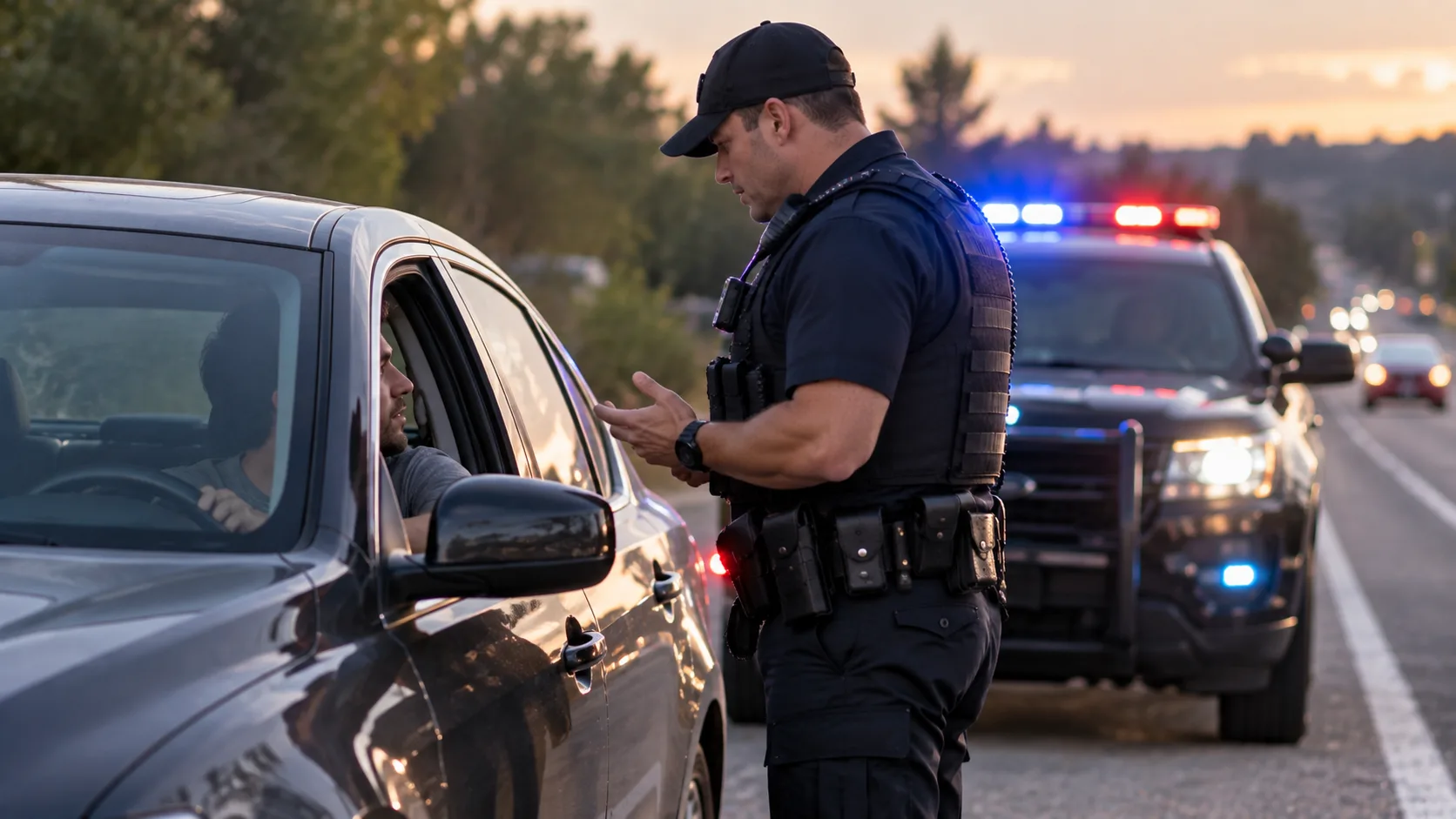
Police encounters · Traffic-stop questions
Do You Have to Tell Police Where You Are Going During a Traffic Stop?
Police can ask where you are going during a traffic stop, but driver document duties and investigative questions are different. Learn the general U.S. rule.
Independent educational reference. Not a police agency, hiring decision, or legal opinion.How we use sources.
Do you have to tell police where you are going during a traffic stop?
Usually, not simply because an officer asks.
TheACLU's current Stopped by Police guidespecifically says people generally do not have to answer questions about where they are going, where they are traveling from, what they are doing, or where they live.
For drivers, however, the answer needs an important qualification. Operating a vehicle can create document and identification duties under state traffic law. A driver may be required to provide a driver's license, registration, and proof of insurance even while choosing not to answer broader investigative questions.
That is why a response such as “I do not want to answer questions” should not be treated as a refusal to provide required driving documents.
Can an officer still ask where you are going?
Yes. The fact that you may not be required to answer does not mean the officer is prohibited from asking.
Police may ask routine or investigative questions during a lawful traffic stop. Questions such as “Where are you headed?”, “Where are you coming from?”, “What were you doing there?”, or “Do you know why I stopped you?” can be part of the conversation.
An officer may be comparing answers among occupants, trying to understand behavior observed before the stop, investigating possible impairment, or simply gathering information.
Whether the question is permissible and whether you are legally required to provide an answer are two different issues.
The ACLU's separateguide to law-enforcement questioningmakes the same distinction: police can ask questions, while people generally retain the right not to answer, subject to limited identification and driving-related requirements.
Driver documents are different from destination questions
A traffic stop involves a driver operating a regulated vehicle on a public roadway. State law commonly requires drivers to possess and produce specified documents.
The ordinary categories include:
- a valid driver's license;
- vehicle registration; and
- proof of insurance or other required financial-responsibility evidence.
The exact requirements and whether electronic proof is accepted vary by state.
The Supreme Court'sRodriguez v. United Statesdecision describes checking a driver's license, outstanding warrants, registration, and proof of insurance as ordinary inquiries associated with a traffic stop.
“Where are you going?” is different. It is not itself one of those ordinary vehicle-document checks.
A driver can therefore comply with the document request without volunteering a travel history or destination.
What does Berkemer v. McCarty say about roadside questions?
Berkemer v. McCartyis an important Supreme Court case about questioning during traffic stops.
The Court held that an ordinary roadside traffic stop is generally not “custody” for Miranda purposes. That means officers normally do not have to give Miranda warnings before asking routine roadside questions during an ordinary temporary stop.
But the Court's discussion also explains that investigative detentions can include a moderate number of questions aimed at identifying the person and confirming or dispelling suspicion, while the detainee generally is not obliged to respond.
This distinction matters. “The officer did not read me Miranda” does not automatically mean the officer was prohibited from asking where you were going. At the same time, the absence of Miranda warnings does not create a new duty to answer every question asked during the roadside encounter.
Miranda custody can arise later if the stop becomes the practical equivalent of formal arrest. OurMiranda-after-arrest guidecovers that separate issue.
Can police ask questions unrelated to the traffic violation?
Yes, at least within the limits on the duration and legality of the stop.
InArizona v. Johnson, the Supreme Court explained that questions unrelated to the original reason for a traffic stop do not automatically make the detention unlawful so long as those inquiries do not measurably extend the stop.
For example, an officer investigating a speeding violation might also ask about travel plans, occupants, weapons, drugs, or other subjects.
The officer's ability to ask does not necessarily create a legal requirement for the driver to answer.
If you do not want to answer, a short response is usually easier to understand than debating the question's relevance.
You can say, “I prefer not to answer questions,” while continuing to follow lawful traffic-stop instructions.
Can police prolong the stop to keep asking unrelated questions?
The Fourth Amendment places limits on the duration of a traffic stop.
Rodriguez v. United States says the authority for a traffic seizure normally ends when the tasks tied to the traffic violation are—or reasonably should have been—completed.
The Supreme Court allows certain unrelated inquiries while a lawful traffic stop is otherwise underway. But officers generally may not add time to the stop solely to pursue an unrelated investigation unless they have an independent lawful justification, such as reasonable suspicion.
That rule applies to the duration of the stop, not merely to the wording of one question.
A brief question about your destination asked while an officer is checking your license does not necessarily prolong the stop at all. A prolonged detention after traffic tasks are complete raises a different question.
If duration later matters, record the sequence instead of only the total number of minutes: when documents were requested, when they were returned, when the citation or warning was completed, what unrelated questioning occurred, and when you were told you could leave.
Identification laws are a separate issue
Questions about your travel destination should not be confused with laws requiring identification in certain circumstances.
InHiibel v. Sixth Judicial District Court, the Supreme Court upheld application of a Nevada law requiring a person lawfully detained under specified circumstances to identify himself.
The Nevada rule at issue required disclosure of identity. It did not create a general obligation to answer every police question.
State identification laws differ, and a driver's duties can also differ from those of a pedestrian or passenger.
OurStop and Identify Laws by Statetool can help locate a cited state statute. Read the actual law for the jurisdiction involved rather than assuming every state uses the same rule.
For passengers specifically, seeDoes a Passenger Have to Show ID During a Traffic Stop?.
How can you decline to answer without escalating the stop?
Keep the response short and calm.
Examples include:
- “I prefer not to answer questions.”
- “I am choosing to remain silent.”
- “I can provide my license and required documents, but I do not want to answer investigative questions.”
Do not use your choice to remain silent as a reason to ignore safety instructions. An officer may still lawfully direct you to remain in the vehicle, exit the vehicle, keep your hands visible, or take another action supported by traffic-stop authority.
If the officer continues asking questions, you do not need to repeatedly argue the law. You can calmly restate that you do not wish to answer.
TheRight to Remain Silent guideprovides more detail about questioning, custody, Miranda, and requests for counsel.
Remaining silent is different from lying
If you do not want to disclose your destination, silence is safer than inventing a false story.
The ACLU's law-enforcement questioning guidance specifically warns that knowingly giving false information to government officials can create legal problems, while remaining silent is different from making a false statement.
Do not create a fake destination, false name, false document, or fictional explanation simply because you believe the officer's question is irrelevant.
If applicable law requires a particular document or identifying information, provide what is legally required. For other questions you do not wish to answer, clearly decline rather than fabricating an answer.
If you already answered one question, that does not necessarily mean you must keep answering every later question. You can decide to stop discussing the matter.
This guide does not cover every travel-related police encounter
This page addresses an ordinary state or local traffic stop inside the United States.
Different rules and legal issues can arise at:
- international borders and ports of entry;
- immigration checkpoints;
- airports and customs inspections;
- commercial vehicle inspections;
- DUI or impaired-driving investigations;
- probation or parole encounters;
- situations involving a warrant or another independent investigation.
A DUI investigation, for example, can involve observations, testing, and implied-consent rules that are different from whether you must casually explain where you were headed.
Do not use a general “right to remain silent” statement to assume that every traffic-related statutory duty disappears.
What should you document after a disputed stop?
If questioning or stop duration later matters, write a factual timeline.
Record the reason given for the stop, the documents requested, the questions asked about your travel, whether you answered or declined, and whether the officer explained why additional detention was occurring.
Note when your documents were returned, when any citation or warning was issued, whether a search request occurred, and when you were told you could leave.
Preserve original video, dash-camera footage you possess, citations, warnings, tow paperwork, and other records.
If a criminal charge resulted, provide the timeline to a lawyer in the relevant jurisdiction. A general guide cannot determine whether a particular question, detention, or refusal affected that case.
What to do next
The cleanest distinction is this: police may ask where you are going, but asking a question is not the same as creating a nationwide legal duty to answer it.
Drivers should still comply with lawful requirements to provide driving documents and with legitimate safety instructions. If you do not want to discuss your destination or travel history, state that choice calmly instead of lying.
For the broader encounter, readWhat Are My Rights During a Traffic Stop?. For questioning generally, readDo You Have to Answer Police Questions?. For state identification statutes, use theStop and Identify Laws by Statetool.
This page provides general U.S. legal background for ordinary traffic stops. State statutes and the facts of a particular encounter can change the analysis.
Frequently asked questions
Do I have to tell police where I am going during a traffic stop?
In an ordinary U.S. traffic stop, there is generally no nationwide rule requiring a driver to answer investigative questions about where they are going or where they came from. Driver duties such as producing a license, registration, and proof of insurance are separate and depend on state law.
Can a police officer ask where I am going?
Yes. Officers may ask questions during a lawful traffic stop, including questions unrelated to the original traffic violation. Whether you are legally required to answer is a separate question.
Can I just say I do not want to answer?
A clear, calm response such as “I prefer not to answer questions” or “I am choosing to remain silent” is generally safer than arguing or giving false information. Continue complying with lawful document and safety instructions.
Can police keep me longer because I will not say where I am going?
A lawful traffic stop may continue while officers complete its traffic-related mission. Supreme Court cases allow unrelated questions that do not measurably extend the stop, but absent separate reasonable suspicion police generally may not add time solely for unrelated investigation.
Sources and verification
Use the linked source for its stated jurisdiction. Requirements and procedures can change; check the current agency notice before acting.
- ACLU: Stopped by Police — questions about where you are going checked
- ACLU: What To Do When Encountering Questions from Law Enforcement checked
- U.S. Supreme Court: Berkemer v. McCarty — roadside questioning during a traffic stop checked
- U.S. Supreme Court: Arizona v. Johnson — unrelated questions during a traffic stop checked
- U.S. Supreme Court: Rodriguez v. United States — limits on extending a traffic stop checked
- U.S. Supreme Court: Hiibel v. Sixth Judicial District Court — state identification requirements checked
Found an error? Send the page URL and a supporting source to[email protected].