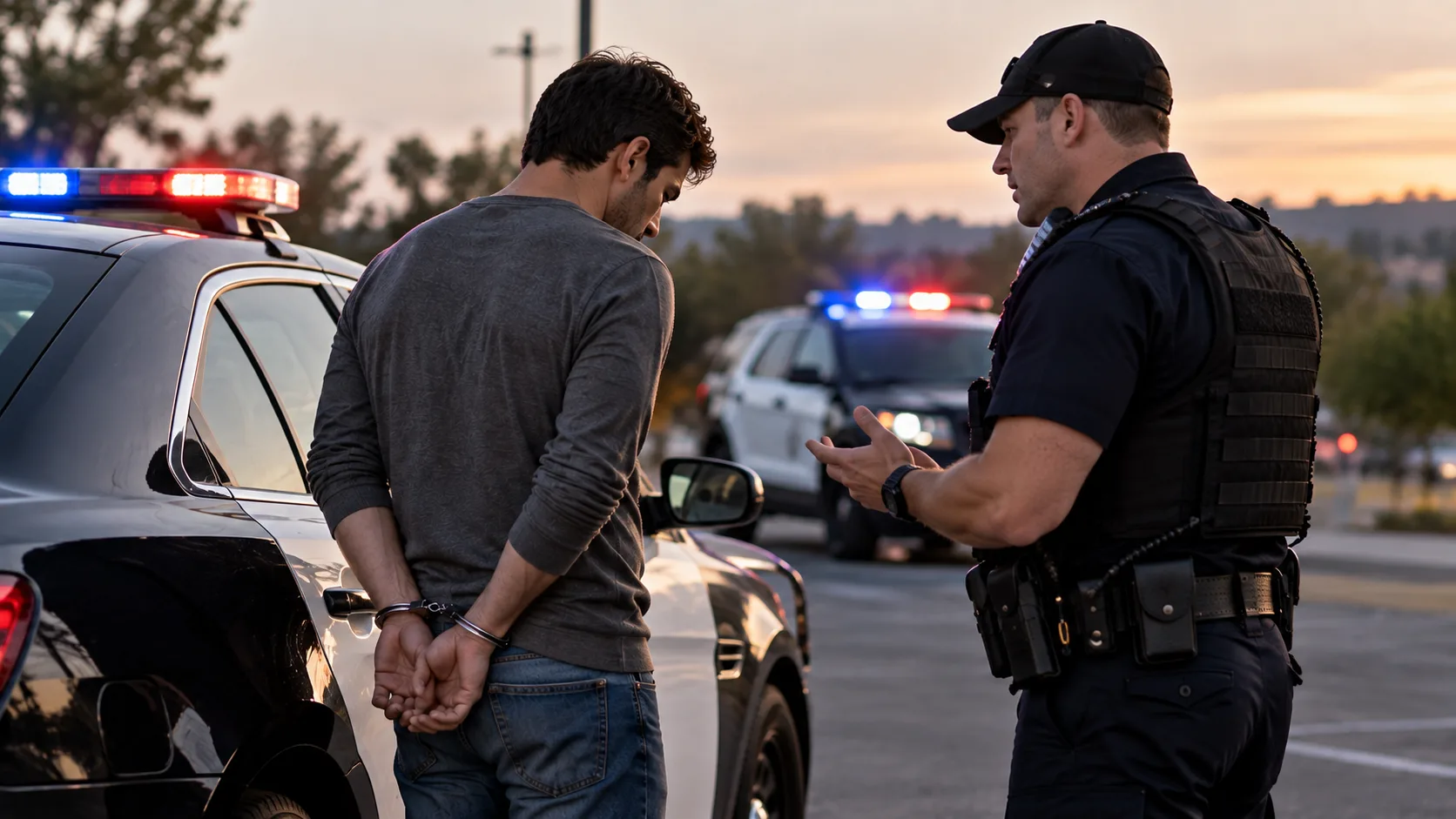
Police encounters · Miranda and questioning
Do Police Have to Read Miranda Rights When They Arrest You?
Police do not have to read Miranda rights simply because an arrest occurs. Learn when custodial interrogation triggers warnings and what happens without them.
Independent educational reference. Not a police agency, hiring decision, or legal opinion.How we use sources.
Do police have to read Miranda rights as soon as they arrest you?
No. Movies and television often make the warning look like a required script that must be recited immediately when handcuffs go on. That is not the federal constitutional rule.
The central Supreme Court decision,Miranda v. Arizona, concerns statements obtained through custodial interrogation. Before police conduct that kind of questioning, the person must generally be advised of the right to remain silent, that statements can be used against them, and the right to counsel.
The arrest itself and the questioning that follows are therefore separate events. Police may arrest a person, secure them, transport them, complete routine booking procedures, or wait before beginning investigative questioning.
If no custodial interrogation occurs, the absence of an immediate Miranda warning does not by itself make the arrest invalid.
What actually triggers Miranda warnings?
The general rule has two major parts:
- Custody: the person must be in custody for Miranda purposes; and
- Interrogation: police must be questioning the person or using conduct that qualifies as interrogation.
If one of those elements is missing, Miranda may not apply at that moment.
For example, a person can be arrested and sit silently in a patrol car without being interrogated. Conversely, police can ask questions during an encounter where the person is not yet in Miranda custody.
The warning becomes important when custody and interrogation come together.
What counts as custody for Miranda purposes?
Formal arrest is a strong example of custody, but Miranda custody is not limited to situations where an officer uses the word “arrest.”
Courts examine the objective circumstances and ask whether the restraint on the person's freedom is comparable to formal arrest.
InHowes v. Fields, the Supreme Court emphasized that restrictions on freedom of movement are relevant but not always sufficient by themselves. The question also considers whether the environment creates the coercive pressures associated with the type of custodial questioning addressed in Miranda.
Location alone does not decide the issue. Questioning at a police station can sometimes be noncustodial, while questioning somewhere else can become custodial depending on the circumstances.
Factors can include whether the person was told they were free to leave, how long the questioning lasted, the degree of physical restraint, the location, the number of officers, and the overall character of the encounter.
What counts as interrogation?
Interrogation is broader than a detective directly asking, “Did you commit the crime?”
InRhode Island v. Innis, the Supreme Court explained that interrogation includes express questioning and its functional equivalent.
That can include police words or conduct that officers should know are reasonably likely to elicit an incriminating response.
Not every statement made by police in the presence of a detained person qualifies. The analysis depends on whether the conduct is reasonably likely to produce an incriminating response rather than merely whether the person happens to respond.
This distinction matters when someone voluntarily speaks without being asked an investigative question. Miranda does not generally prevent police from hearing and documenting a truly volunteered statement.
Why ordinary traffic stops usually do not require Miranda warnings
A traffic stop restricts a driver's freedom, but the Supreme Court has held that an ordinary roadside stop is generally not Miranda custody.
InBerkemer v. McCarty, the Court explained that the typical traffic stop is temporary, relatively brief, and usually occurs in public. Those features make it different from the station-house custodial interrogation at the center of Miranda.
That means an officer can ordinarily ask roadside questions during a routine stop without first reading Miranda warnings.
The analysis can change if the encounter becomes the functional equivalent of formal arrest. A traffic stop is not permanently exempt from Miranda simply because it started with a traffic violation.
For broader roadside issues, readWhat Are My Rights During a Traffic Stop?.
What if police arrest you but do not ask questions?
If police arrest someone but do not conduct custodial interrogation, there may be no immediate Miranda event to analyze.
Officers can perform safety procedures, transport the person, inventory property according to applicable rules, and complete administrative steps without necessarily interrogating them.
Routine booking questions can also raise different issues from investigative questions designed to obtain incriminating information.
A person should not assume, however, that silence from police means anything said voluntarily is consequence-free. Statements can matter even when the officer did not ask the question that prompted them.
If you do not want to discuss the facts of a suspected offense, clearly state that you want to remain silent and want a lawyer rather than trying to explain your way out of the situation.
What happens if police question you without giving Miranda warnings?
The most common misconception is that an arrest must automatically be dismissed because Miranda warnings were not given.
That is not the ordinary remedy. Miranda principally affects the use of statements obtained through custodial interrogation without the required safeguards.
Whether a statement can be suppressed depends on the circumstances, including whether the person was actually in custody, whether interrogation occurred, whether warnings were given, whether rights were invoked, and whether any waiver was knowing, intelligent, and voluntary.
The legality of the arrest itself generally depends on a separate question such as probable cause. A Miranda problem does not automatically erase evidence unrelated to the unwarned statement or invalidate an otherwise lawful arrest.
If criminal charges are pending, a defense lawyer can evaluate the exact questioning, recording, timing, and statements.
How should you state that you want to remain silent?
Do not rely only on silence, body language, or the assumption that officers know what you intend.
A clear statement is easier to document. For example:
“I am choosing to remain silent. I want a lawyer.”
After stating that choice, avoid continuing to discuss the suspected offense.
This is different from refusing routine instructions related to safety, identification requirements that may lawfully apply, fingerprinting, booking procedures, or other obligations.
OurRight to Remain Silent guideexplains questioning, custody, Miranda, and requests for counsel in more detail.
What should you document afterward?
If Miranda becomes important later, timing matters.
Write down when you were stopped, when you were told you were under arrest, when handcuffs were applied, when questioning began, where questioning occurred, whether warnings were read, and what happened after any request to remain silent or speak with a lawyer.
Preserve booking paperwork, citation or arrest documents, video, audio, messages, and other records.
Do not rely on memory of a television version of the Miranda warning. Different jurisdictions may use different wording so long as the required rights are reasonably communicated.
If a statement is being used in a criminal case, provide the timeline to your lawyer rather than trying to determine admissibility from a general website.
What to do next
The shortest accurate rule is: arrest alone does not automatically trigger a Miranda warning; custodial interrogation does.
For questioning and silence, readDo You Have to Answer Police Questions?. For the steps that follow an arrest, readWhat to Do If You're Arrested. For a quick scenario reference, useWhat to Do If Police Stop You.
This guide provides general U.S. federal constitutional background. Whether Miranda applied to a specific statement depends on the facts, the questioning, the custody circumstances, and the governing court decisions.
Frequently asked questions
Do police have to read Miranda rights the moment they arrest you?
No. Miranda warnings are generally required before custodial interrogation, not automatically at the instant of arrest. Police can arrest someone and transport or book them without immediately giving Miranda warnings if they are not conducting custodial interrogation.
Can police arrest you without reading Miranda rights?
Yes. Failure to give Miranda warnings does not automatically invalidate an otherwise lawful arrest. The main Miranda issue is whether statements from custodial interrogation may be used against the person.
When do police have to read Miranda rights?
The general rule applies before custodial interrogation: the person must be in custody for Miranda purposes and police must be interrogating or using words or conduct reasonably likely to elicit an incriminating response.
Do Miranda rights apply during every traffic stop?
No. Berkemer v. McCarty held that an ordinary temporary traffic stop is generally not Miranda custody. If the encounter later becomes the functional equivalent of formal arrest, the analysis can change.
Sources and verification
Use the linked source for its stated jurisdiction. Requirements and procedures can change; check the current agency notice before acting.
- U.S. Supreme Court: Miranda v. Arizona — custodial interrogation warnings checked
- U.S. Supreme Court: Berkemer v. McCarty — traffic stops and Miranda custody checked
- U.S. Supreme Court: Rhode Island v. Innis — what counts as interrogation checked
- U.S. Supreme Court: Howes v. Fields — custody analysis checked
Found an error? Send the page URL and a supporting source to[email protected].