Police encounters · License-plate checks
Can Police Stop a Car Because the Registered Owner's License Is Suspended?
Police may sometimes stop a car based on the registered owner's license status. Learn what Kansas v. Glover held and the limits of the owner-is-driver inference.
Independent educational reference. Not a police agency, hiring decision, or legal opinion.How we use sources.
Can police stop a car because the registered owner's license is suspended?
Sometimes. The Fourth Amendment allows a brief investigative traffic stop when an officer has reasonable suspicion that a traffic or criminal violation is occurring.
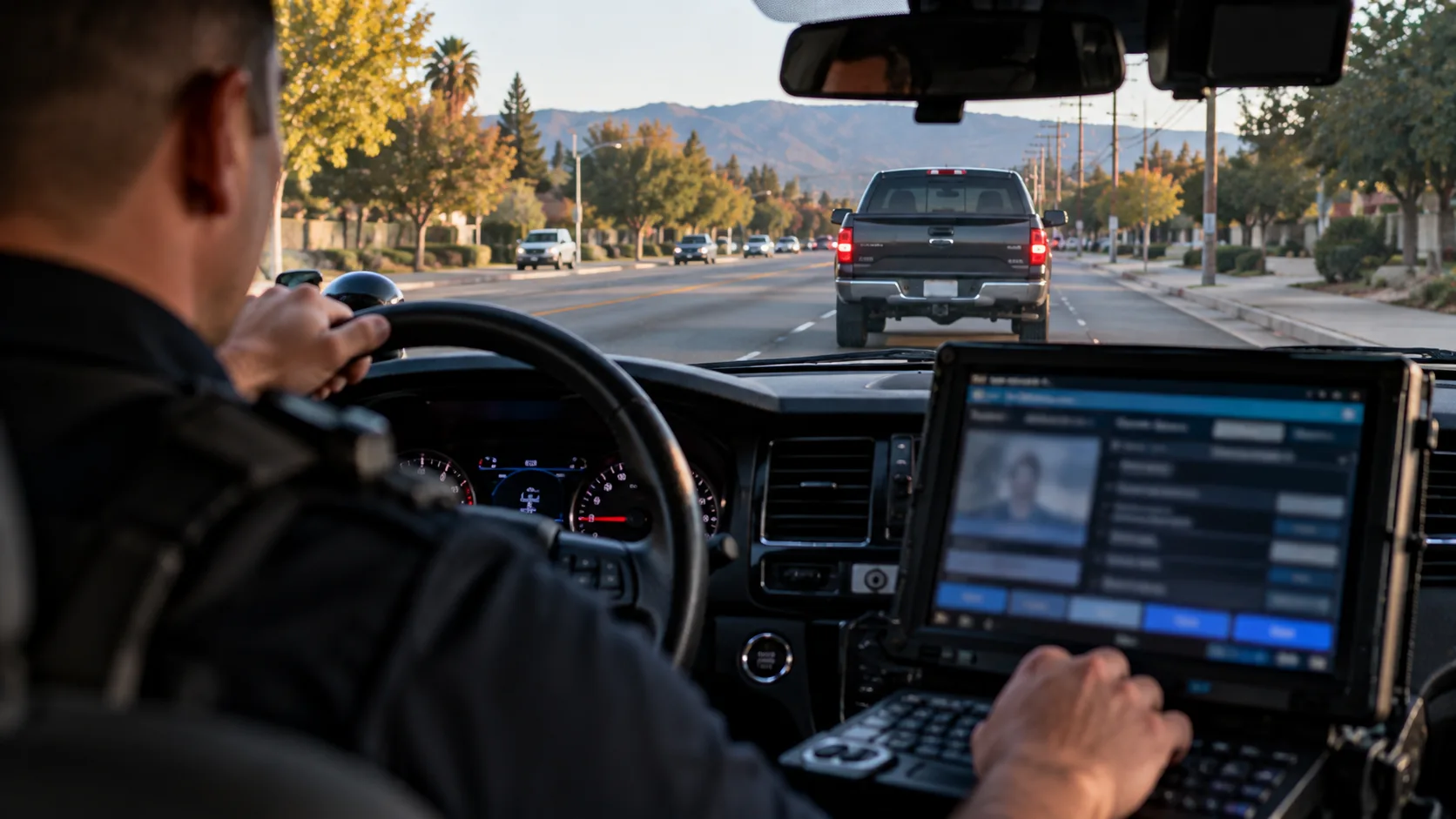
One way that suspicion can develop is through a license-plate check. The officer may learn that the vehicle is registered to a person whose driver's license is suspended, revoked, or otherwise invalid.
The officer still does not necessarily know who is physically behind the wheel. A spouse, child, friend, employee, or another licensed person may be driving the owner's car legally.
The Supreme Court addressed that uncertainty inKansas v. Glover. The Court concluded that reasonable suspicion can rest on a common-sense inference that the registered owner is the driver when the facts known to the officer do not undermine that inference.
What Kansas v. Glover actually held
The facts of Glover are important because the decision is often summarized too broadly.
A Kansas deputy observed a pickup truck, ran its license plate, and learned that the registered owner, Charles Glover Jr., had a revoked driver's license.
The deputy did not observe a separate traffic violation before making the stop and did not visually identify the driver first.
He inferred that the registered owner was likely driving the registered owner's truck and initiated the traffic stop. Glover was in fact behind the wheel.
The Supreme Court held that the stop was reasonable because the deputy knew three relevant facts: the observed vehicle matched the registration, the registered owner had a revoked license, and the officer had no information contradicting the inference that the owner was driving.
The Court described this as a common-sense judgment about human behavior rather than an unsupported hunch.
Revoked and suspended licenses are not identical
This distinction deserves to be explicit.
Glover itself involved a revoked Kansas driver's license. The Supreme Court did not write a nationwide vehicle-code rule saying that every registration linked to every kind of license suspension automatically authorizes a stop.
States use terms such as suspended, revoked, canceled, invalid, or withdrawn differently. The underlying reasons and legal consequences can also differ.
The Fourth Amendment question remains whether the facts known to the officer create an objectively reasonable suspicion that the person currently driving is doing so unlawfully.
Glover is highly relevant to suspended-owner cases because of its owner-is-driver reasoning, but a careful analysis should still check the state's law, the status returned by the database, and any additional information the officer knew.
Do not turn a Supreme Court decision involving a revoked Kansas license into a fictional national statute governing every suspension.
Why may police infer that the registered owner is driving?
Reasonable suspicion does not require certainty.
The Supreme Court has repeatedly explained that officers can draw reasonable inferences from specific facts and the practical considerations of everyday life.
In Glover, the officer knew the vehicle's plate was registered to a particular owner, knew the owner's license was revoked, and saw a vehicle matching the registration.
The Court said it was reasonable to infer that the registered owner might be the person driving the registered owner's vehicle.
The fact that owners sometimes lend their vehicles to other people did not make the inference unreasonable. Reasonable suspicion can exist even though an innocent explanation is possible.
The Court also emphasized that the standard falls well below the certainty required for conviction and below probable cause.
That is why an officer does not necessarily need a photograph-quality view of the driver before initiating the brief stop.
What information can defeat the inference that the owner is driving?
Glover contains an important limitation: the officer lacked information negating the inference that the owner was driving.
If an officer knows facts before the stop that make it unreasonable to believe the owner is behind the wheel, the analysis can change.
Imagine that the registered owner information clearly identifies an elderly woman, while the officer can plainly see before initiating the stop that the sole driver is a young man. Or suppose the officer already knows from another reliable source that the registered owner is not in the vehicle.
Those facts may undermine the owner-is-driver inference.
The exact effect depends on how clear the contradictory information is and what the officer actually knew at the moment the seizure began.
Glover therefore does not authorize police to consciously ignore obvious facts that defeat the inference.
What happens when police run the license plate?
A plate query can return information associated with the vehicle and registered owner through law-enforcement and motor-vehicle systems.
The exact data available varies by state, agency, system, and the type of query.
At a minimum relevant to Glover, the officer was able to associate the plate with the registered vehicle owner and determine the owner's driver's-license status.
That does not mean every officer sees every personal detail imaginable whenever a plate is checked.
Our next dedicated guide will addresswhat police can see when they run a license plateand distinguish vehicle-registration information from separate driver, warrant, and criminal-history systems.
The important point for this page is that license status connected to a registered owner can become part of the reasonable-suspicion analysis.
Does the officer need to observe another traffic violation first?
Not necessarily.
In Glover, the parties stipulated that the deputy did not observe a separate traffic infraction before stopping the truck.
The suspected violation was that the registered owner—whose license had been revoked—was driving the vehicle.
The Supreme Court held that the plate information plus the owner-as-driver inference supplied reasonable suspicion under those circumstances.
This is different from randomly stopping vehicles merely to see whether drivers have valid licenses.
InDelaware v. Prouse, the Supreme Court held that, absent reasonable suspicion, officers generally may not stop a vehicle at random simply to check the driver's license and vehicle registration.
Glover involved specific information tied to a particular registered vehicle and owner rather than a suspicionless random check.
What Kansas v. Glover does not authorize
Glover should not be read as unlimited authority to stop any car whenever an owner has ever had a licensing problem.
The decision depends on current facts known to the officer and an objectively reasonable inference.
It does not say:
- the registered owner is legally presumed to be driving in every circumstance;
- police may ignore information showing that someone else is driving;
- a plate query automatically authorizes a search of the vehicle;
- the driver can automatically be arrested merely because the owner has a license problem;
- every state defines suspension and revocation the same way; or
- police can randomly stop vehicles without reasonable suspicion.
The case addresses the initial investigative stop. Later detention, questioning, frisking, searching, ticketing, and arrest each require their own legal basis.
What happens after police stop the vehicle?
Once the officer reaches the vehicle, the original inference can quickly be confirmed or undermined.
The driver can be asked for the driver's license and other documents required under state law.
If the driver is the registered owner and the license remains suspended or revoked, the officer can address that violation under applicable state law.
If another licensed person is driving, the reason that initially justified the stop may be dispelled.
That does not necessarily require the officer to vanish instantly without completing ordinary safety and identity-related tasks connected to resolving the stop, but the officer cannot use the original suspicion indefinitely after it has been disproved.
Any additional offense or independent reasonable suspicion discovered during the encounter can create a separate basis for lawful police action.
For stop-duration limits generally, readCan Police Extend a Traffic Stop After Writing a Ticket?.
What should you document after a disputed owner-license stop?
If you believe the officer should have known that the registered owner was not driving, preserve the facts that bear on that issue.
Record the date, time, location, reason the officer gave for the stop, who actually owned the vehicle, who was driving, and what could reasonably be seen about the driver's identity before the stop.
Note whether the officer said that a plate check showed a suspended or revoked owner and whether the officer described any additional reason for the stop.
Keep the citation, warning, body-camera or dash-camera request information, and any other paperwork.
If the stop resulted in a search, arrest, criminal charge, or seized evidence, a lawyer in the relevant jurisdiction can review whether Glover applies to the actual license status and the facts known to the officer before the seizure.
What to do next
Kansas v. Glover establishes that police do not always have to visually confirm the driver's identity before stopping a vehicle whose registered owner has a revoked license. When no information negates the inference, the owner-is-driver assumption can support reasonable suspicion.
But Glover should be described accurately: it involved a revoked license, not a blanket nationwide rule covering every suspension category.
For the broader stop framework, readWhat Are My Rights During a Traffic Stop?. For unrelated questioning after the stop begins, readCan Police Ask Unrelated Questions During a Traffic Stop?.
The next guide in this series explains what information may appear when police run a vehicle's license plate and why registration, driver-license status, warrants, and criminal-history records should not be treated as one single database result.
Frequently asked questions
Can police pull over a car because the registered owner has a suspended license?
Potentially, yes. Kansas v. Glover held that an officer may reasonably infer that a vehicle’s registered owner is driving when a plate check shows the owner has a revoked license and the officer has no information negating that inference. Glover involved revocation, not a universal rule for every type of suspension, so state law and the actual license status still matter.
Did Kansas v. Glover involve a suspended license?
No. The registered owner in Kansas v. Glover had a revoked driver’s license. The Supreme Court’s reasoning concerned whether it was reasonable to infer that the registered owner was the driver when the officer had no contrary information.
Do police have to confirm the owner is driving before making the stop?
Not always. Glover rejected a rule requiring officers to visually confirm the registered owner before initiating the stop when the plate, vehicle, and revoked-owner information supported a reasonable inference and nothing known to the officer contradicted it.
What if the driver obviously does not match the registered owner?
Kansas v. Glover expressly limited its holding to situations where the officer lacks information negating the inference that the owner is driving. Facts known before the stop that clearly contradict the owner-as-driver inference can change the reasonable-suspicion analysis.
Sources and verification
Use the linked source for its stated jurisdiction. Requirements and procedures can change; check the current agency notice before acting.
- U.S. Supreme Court: Kansas v. Glover — registered owner with revoked license checked
- U.S. Supreme Court: Kansas v. Glover — official opinion checked
- U.S. Supreme Court: Delaware v. Prouse — random license and registration stops checked
- U.S. Supreme Court: United States v. Cortez — reasonable suspicion and objective basis checked
Found an error? Send the page URL and a supporting source to[email protected].