Police careers · Hiring interviews
What Happens in a Police Oral Board Interview?
Learn what happens in a police oral board interview, what panels evaluate, common question types, scenario answers, preparation, and what happens next.
Independent educational reference. Not a police agency, hiring decision, or legal opinion.How we use sources.
What happens in a police oral board interview?
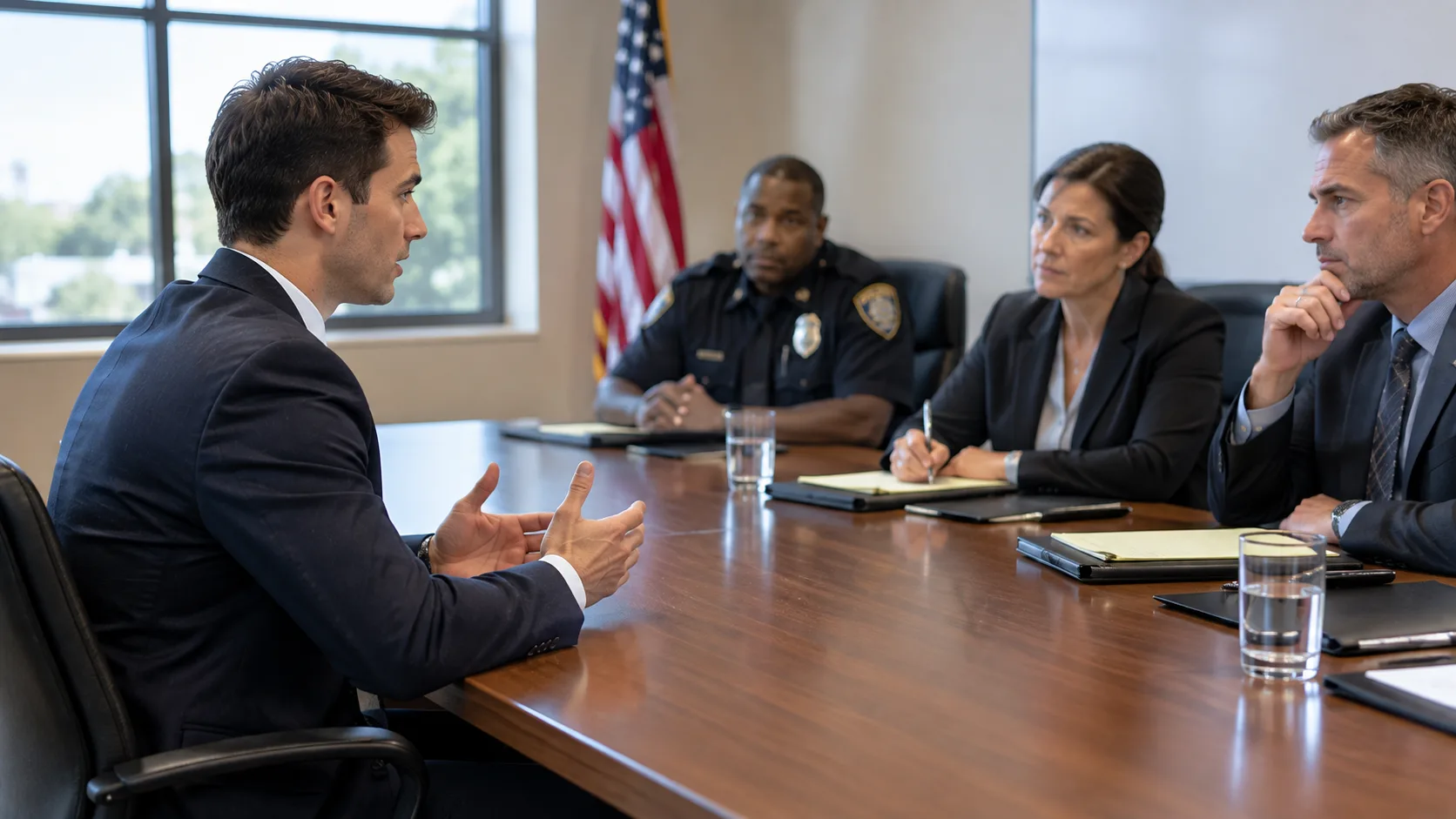
A police oral board is not one standardized national examination. It is an interview stage used by many law-enforcement employers to evaluate applicants in a structured setting.
Depending on the agency, the oral board can occur after a written exam, physical test, initial screening, or another early hiring step. It can also happen later for lateral applicants or promotional positions.
CurrentGoodyear Police Department recruiting materialsays applicants who complete earlier testing may be invited to an oral board made up of sworn and civilian department members. Candidates are evaluated on problem solving, interpersonal skills, communication, professional demeanor, and appearance.
Coral Springs, Florida similarly lists an oral board as a formal stage in its current law-enforcement trainee selection process before additional examinations and the background investigation.
The important point is that the oral board is usually evaluating more than whether you know police terminology. The panel is watching how you organize information, communicate under pressure, make decisions, and present yourself as an applicant.
Who sits on a police oral board?
There is no universal panel composition.
An agency can use patrol officers, detectives, sergeants, command staff, civilian employees, human-resources personnel, civil-service examiners, or other designated evaluators.
Goodyear's current police-officer recruitment says its interview panel can include sworn and civilian members of the department. Seattle's Civil Service Department describes oral boards more generally as interview panels used in public-safety hiring and promotional examinations.
Do not assume every person on the panel will be a police officer or that the highest-ranking person will make the entire decision. In structured selection systems, panel members may follow scoring criteria and submit ratings rather than independently deciding whether to hire you.
Treat every panel member with the same professionalism. Make eye contact across the panel rather than directing your entire answer to the person who asked the question.
What are police oral boards evaluating?
The exact competencies depend on the agency, but official recruiting material gives useful examples.
Goodyear currently says candidates are evaluated on:
- Problem-solving ability
- Interpersonal skills
- Communication skills
- Professional demeanor
- Overall appearance
These categories explain why memorizing model answers is usually less useful than understanding how to communicate your reasoning.
A panel may be listening for whether your answer is relevant, organized, complete, realistic, and consistent with professional conduct. The same underlying qualities can be tested through questions about past behavior, hypothetical situations, career motivation, conflict, ethics, or teamwork.
Your agency may publish different competencies or a different scoring method. Read the examination notice and candidate instructions rather than assuming another department's rubric applies.
What kinds of police oral board questions should you expect?
TheSeattle Police Department's oral-board preparation materialrecommends that candidates know their education and employment history, be able to explain why they want a law-enforcement career, understand why they chose that agency, and research the department before the interview.
That points to several common question categories:
- Motivation: Why do you want to become a police officer?
- Agency fit: Why this department rather than another?
- Background: What experience has prepared you for the work?
- Conflict: Tell us about a difficult interaction and how you handled it.
- Judgment: Describe a time you made a difficult decision.
- Ethics: How would you respond to improper conduct?
- Scenario: What would you do in a hypothetical police situation?
- Communication: Explain a decision clearly and logically.
Those are categories rather than guaranteed questions. Do not try to obtain or memorize confidential test questions.
How should you answer scenario-based questions?
Seattle's official preparation guide tells candidates to be prepared for scenario questions and to explain both what they would do and why.
That is a useful structure. A scenario answer should show that you can identify the immediate problem, consider safety, communicate, gather information, use available resources, follow law and policy, and explain your reasoning.
Avoid pretending that an entry-level applicant already knows every department policy. If the scenario depends on a policy you have not been trained on, explain the professional principles you would use and where you would seek direction.
For example, an answer can distinguish between immediate safety decisions and later reporting, supervisor notification, documentation, or evidence preservation.
Listen to every part of the question. Seattle specifically advises candidates to answer all components and ask for clarification sparingly when they genuinely do not understand what was asked.
Prepare a real answer to “Why do you want to be a police officer?”
Generic statements such as “I want to help people” may be sincere, but by themselves they do not show that you understand the job.
Build your answer around concrete experiences, skills, and reasons that connect to the actual work. You might discuss public service, problem solving, communication, responsibility, teamwork, or a career transition, but the answer should be truthful and specific to you.
Also prepare for “Why this department?” Research the department's jurisdiction, organization, recruiting material, current programs, and community rather than repeating a slogan from the home page.
Do not invent familiarity. If you have not completed a ride-along or spoken with an officer from the agency, do not claim that you have.
How to prepare for a police oral board
Preparation should make your answers clearer, not robotic.
Seattle Police recommends practicing answers aloud and even recording yourself. That can reveal whether an answer is too long, vague, repetitive, or filled with nervous verbal habits.
Before the interview:
- Review the job announcement and hiring process.
- Research the department using official sources.
- Know the dates and major facts in your own application history.
- Prepare several truthful examples involving teamwork, conflict, judgment, responsibility, and mistakes.
- Practice scenario answers aloud.
- Prepare professional clothing appropriate to the agency's instructions.
- Confirm the location, arrival instructions, parking, identification, and required documents.
- Sleep adequately and arrive early enough to avoid creating unnecessary stress.
Avoid memorizing a full speech word for word. A panel can ask follow-up questions or phrase the issue differently, and a memorized script can make it harder to adapt.
Common oral-board mistakes
One common mistake is answering a different question from the one asked. Listen first, organize your response, and make sure you address every part.
Another is giving extremely long answers. More words do not automatically demonstrate better judgment. State the point, explain the reason, and provide a relevant example when needed.
Do not criticize previous employers, exaggerate experience, invent police knowledge, or give an answer you think the panel wants if it is not truthful.
Avoid presenting every scenario as though force or arrest is the first solution. Entry-level oral boards can evaluate communication, proportional judgment, problem solving, safety, and use of resources—not just enforcement vocabulary.
Finally, do not treat professional appearance as a substitute for content. Goodyear lists both demeanor and appearance among its evaluation areas, but communication and problem solving are also explicit parts of the assessment.
What happens after the police oral board?
The next step varies by agency.
Current Goodyear recruiting material says applicants who pass the oral board move into the background-investigation process. Coral Springs lists additional testing, an interview with the police chief, background investigation, psychological evaluation, and post-offer medical testing among later stages.
Passing an oral board therefore usually does not mean you have been hired. It means you have successfully completed one part of the selection process.
An agency may rank candidates, create an eligibility list, invite only selected applicants to continue, or require a minimum passing score. Check the current notice for your recruitment.
If you do not pass, read the agency's retest or reapplication rule before immediately submitting another application. Goodyear's current recruitment, for example, specifies a waiting period before unsuccessful oral-board candidates may reapply.
What to do next
Treat the oral board as a structured professional interview, not a trivia contest. Know your history, understand the department, practice communicating aloud, and explain your reasoning rather than giving one-word conclusions.
For the complete hiring sequence, readHow to Become a Police Officer in the U.S.. For the next major screening stage, seePolice Background Check Disqualifiers. Use thePolice Academy Eligibility Checklistto keep requirements for one actual application organized.
The format, scoring, panel composition, and retest rules can change by agency and hiring cycle. Use the current examination notice or recruiting instructions for the department you are applying to.
Frequently asked questions
What is a police oral board interview?
A police oral board is a structured interview conducted by a panel. Depending on the agency, panel members can include sworn officers, supervisors, city employees, human-resources staff, or other authorized evaluators.
What do police oral boards score?
The exact rubric varies by agency. Current Goodyear Police recruiting material says candidates are evaluated on problem-solving ability, interpersonal and communication skills, professional demeanor, and overall appearance.
Are police oral board questions scenario based?
They often can be. Seattle Police preparation material tells candidates to understand what officers do and be ready for scenario-based questions, including explaining both what they would do and why.
Can you fail a police oral board interview?
Yes. An oral board can be a scored or pass/fail stage of the selection process. Agencies set their own passing standards and rules for reapplying or retesting.
Sources and verification
Use the linked source for its stated jurisdiction. Requirements and procedures can change; check the current agency notice before acting.
- Seattle Police Department: Preparing Yourself for Your Police Oral Board checked
- City of Goodyear: Police Officer Recruitment — Oral Board Interview checked
- City of Coral Springs: Law Enforcement Trainee 2026 — Selection Process checked
- Seattle Civil Service Department: 2025 Annual Report — Oral Boards and Public Safety Hiring checked
Found an error? Send the page URL and a supporting source to[email protected].