Police careers · Age requirements
Can You Become a Police Officer at 40? Age Limits Explained
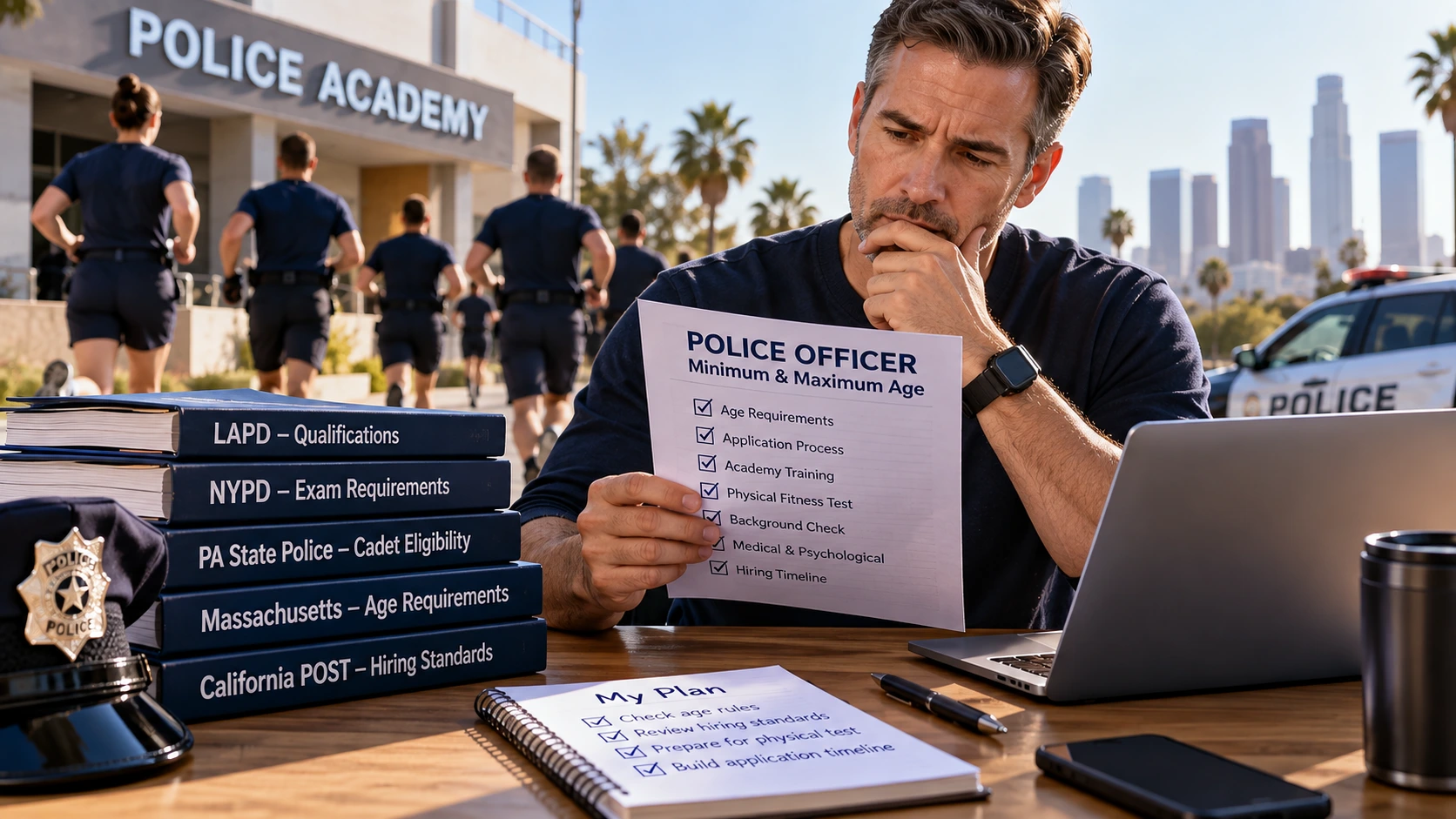
Yes, some police departments hire applicants at 40 or older, while others impose maximum ages. Compare current LAPD, NYPD, Pennsylvania and Massachusetts rules.
Independent educational reference. Not a police agency, hiring decision, or legal opinion.How we use sources.
Can you become a police officer at 40?
Turning 40 does not automatically prevent someone from beginning a police career in the United States. Whether you are eligible depends on the law and hiring rules that apply to the specific police department, sheriff's office, state-police agency, or other peace-officer position.
Current official recruiting materials show why a national yes-or-no answer would be misleading. TheLos Angeles Police Departmentstates that it does not impose a maximum age limit to apply or work as an LAPD officer. New York City currently accepts Police Officer exam applicants who are under 43 when they file. Pennsylvania State Police uses a different approach and requires new cadets to have not reached age 40 at appointment.
That means a 40-year-old applicant could satisfy the age rule for one police department while being outside the permitted age range for another position on the same day.
The first question should therefore be: Which exact agency and job classification are you applying to?
There is no single national maximum police-officer age
Police hiring in the United States is decentralized. State law may establish minimum or maximum requirements, and local agencies can sometimes impose additional standards.
California provides a clear example. TheCalifornia Commission on Peace Officer Standards and Traininglists a statewide minimum age of 21 for specified peace officers at appointment. Its published statewide standards do not create one California-wide maximum age for ordinary police applicants.
California POST separately explains that local law-enforcement agencies may set standards higher than the statewide minimums. An applicant should therefore check both the state standard and the hiring department’s current job announcement.
This distinction matters far beyond California. A statewide police agency, municipal civil-service department, city police department, county sheriff, transit agency, university police department, or other law-enforcement employer can operate under a different statutory and hiring framework.
Current police-officer age-limit examples
The following examples show how much the answer can vary. They should be used only for the named agency or jurisdiction and checked again before applying.
| Agency or jurisdiction | Published age rule | What it means for an applicant age 40 |
|---|---|---|
| Los Angeles Police Department | No maximum age limit published by LAPD | Age 40 does not by itself exceed LAPD’s age requirement. |
| New York City Police Officer exam | Applicant must be under 43 on the filing date | A 40-year-old can satisfy the current age rule. |
| Pennsylvania State Police | Applicant cannot have reached age 40 at appointment | A person already age 40 would not meet that cadet rule. |
| Massachusetts municipalities | Varies: some use maximum 32, Boston uses under 40, others have no upper limit | Eligibility depends on the municipality. |
The table is not intended as a list of the best agencies for older applicants. It illustrates why a search result saying “the police age limit is 35” or “there is no age limit” should not be treated as a national rule.
Some police departments publish no maximum age limit
LAPD is a useful current example for someone asking whether age 40 is automatically too late.
LAPD’sofficial qualifications pagesays an applicant must be at least 20 at application and 21 by police-academy graduation. The department also expressly states that it does not impose a maximum age limit to apply or work as an LAPD officer.
That does not mean a 40-year-old applicant skips any part of the selection process. The applicant must still satisfy the department’s education, employment-authorization, background, testing, medical, psychological, physical, and other current requirements.
“No maximum age” should therefore be read narrowly: age itself is not the upper-limit disqualifier. It is not a guarantee of appointment.
NYPD currently allows applicants under 43
New York City is an especially useful example of why old search results can become inaccurate.
For years, NYPD material commonly referred to a maximum age of 35. In 2026, New York City enactedLocal Law 2026/131, raising the maximum filing age for the Police Officer civil-service examination from 35 to 43.
The currentNYC Police Officer Notice of Examinationreflects the new rule. It says applicants must be less than 43 years of age on the date they file their application for the examination. It also identifies a military-service adjustment that may apply to qualifying applicants.
As a result, an applicant who is 40 can meet the current NYC maximum-age rule, assuming the applicant also satisfies the other requirements.
This is also a good reason to avoid relying on an older NYPD FAQ or forum answer that still says 35. Age rules can change, and the current examination notice is more useful than a historical recruiting page.
Some agencies still impose maximum ages below or around 40
Age 40 is not eligible everywhere.
ThePennsylvania State Policecurrently requires applicants to be at least 20 when applying and at least 21 at appointment, but they cannot have reached their 40th birthday by the appointment date.
For that position, the difference between age 39 and age 40 can therefore be decisive depending on when appointment occurs.
Massachusetts shows another kind of variation. The state’sCivil Service age guidancesays some municipalities use a maximum age of 32 for original police appointments, while other municipalities have no upper age limit. Boston uses its own accepted statutory provision and requires police candidates not to have reached their 40th birthday by the relevant exam date.
A person searching only for “Massachusetts police age limit” could therefore get an answer that is correct for one city but wrong for another.
Application age and appointment age are not always the same thing
When reading an age requirement, pay close attention to the event that triggers the cutoff.
An agency might measure your age on:
- the day you apply;
- the first day of an examination filing period;
- the date you take the written exam;
- the date of appointment;
- the day academy training begins; or
- another date defined by statute or civil-service rule.
New York City’s current rule focuses on age when the application for the Police Officer examination is filed. Pennsylvania State Police focuses on the candidate’s age at appointment. Those are materially different rules.
Do not round your age or assume that being “about 40” is enough information. Check your birth date against the exact cutoff language in the current notice.
Being age-eligible does not replace the other hiring standards
If the department permits applicants at age 40, the applicant must still pass the remainder of that department’s process.
Depending on the agency, that can include a written examination, physical ability testing, structured interview, background investigation, fingerprinting, medical evaluation, psychological evaluation, academy requirements, and other job-specific screening.
California POST, for example, lists statewide minimum selection standards including a background investigation, fingerprints and criminal-history review, education, medical suitability, psychological suitability, and an employment interview in addition to the age requirement.
An older applicant should therefore not focus only on whether a maximum age exists. The practical question is whether the applicant can satisfy all current requirements for that specific vacancy.
For physical-testing questions, see ourPolice Physical Ability Test guide. Test events, scoring, retake rules, and physical standards are agency-specific and should be checked against the actual recruitment notice.
Planning a police career change at 40
Someone changing careers at 40 should build a timeline before leaving an existing job or paying for training.
First, identify several agencies rather than assuming the closest department is the only option. Record the maximum-age wording for each one and the date on which age is measured.
Second, check whether the department hires before academy training or expects applicants to attend an academy through another route. Ourpolice-academy length guideshows why academy schedules can range across different weeks, hours, and delivery formats.
Third, compare the whole hiring calendar. Background investigations and selection stages can take time. If a maximum age is measured at appointment rather than initial application, a candidate close to the cutoff should not assume that applying before a birthday automatically preserves eligibility.
Finally, keep copies of the actual vacancy, exam notice, eligibility page, and any recruiter response. Rules can change between hiring cycles.
How to verify whether you are too old for a specific department
Use a simple four-step check:
- Open the current vacancy or examination notice. Do not start with a forum or an old recruiting article.
- Find both the minimum and maximum age language. Some pages mention only the minimum prominently.
- Identify the cutoff event. Application, test, appointment, and academy-entry dates are not interchangeable.
- Check statutory exceptions. Some systems provide specific military-service adjustments or other exceptions defined by law.
If the wording is unclear, contact the official recruiting or civil-service office and ask a narrow factual question. For example: “I will be 40 years and four months old on the expected appointment date. Does the current Police Officer posting permit appointment at that age?”
Save the response with the job notice. A recruiter’s answer for one department should not be reused as the rule for another department.
What to do next
Age 40 is not a nationwide barrier to becoming a police officer. It is within the current published age rules of some major departments, including LAPD and, as of the 2026 rule change, current New York City Police Officer examinations. Other employers use stricter limits.
Start withHow to Become a Police Officer in the U.S.for the complete hiring sequence. Then use thePolice Academy Eligibility Checklistto record the age, education, work-authorization, driving, and screening requirements for one real job.
If age is the only reason you assumed police work was no longer available, verify the current rule before ruling yourself out. The correct answer comes from the present statute, civil-service notice, or hiring agency—not a nationwide age number copied from another department.
Frequently asked questions
Is 40 too old to become a police officer?
Not necessarily. LAPD currently states that it has no maximum age limit, and current New York City Police Officer examinations allow applicants who are under 43 on the filing date. Other agencies impose lower maximum ages, so the exact employer and appointment rule matter.
Can I join LAPD at 40?
LAPD currently says applicants must be at least 20 when applying and 21 by academy graduation, and that the department does not impose a maximum age limit to apply or work as an LAPD officer. Applicants must still satisfy all other hiring standards.
Can I join NYPD at 40?
Current NYC Police Officer examination material allows applicants who are less than 43 years old on the date they file the application. New York City raised its previous maximum from 35 to 43 in 2026. Always read the notice for the specific exam you are entering.
Can I become a state trooper at 40?
That depends on the state. Pennsylvania State Police currently requires cadets to be at least 21 and to have not reached age 40 at appointment, so a person who has already reached that cutoff would not meet that program’s age rule. Other state-police agencies may use different limits.
Sources and verification
Use the linked source for its stated jurisdiction. Requirements and procedures can change; check the current agency notice before acting.
- LAPD: Police Officer Qualifications — no maximum age limit checked
- California POST: How Do I Become a Peace Officer? checked
- California POST: Peace Officer Local Agency Policy checked
- NYC DCAS: Police Officer Exams 7311–7322 — current age requirement checked
- New York City Council: Local Law 2026/131 — police officer maximum exam age checked
- Pennsylvania State Police: Cadet Eligibility Requirements checked
- Massachusetts Civil Service: Age requirements for entry-level public safety positions checked
Found an error? Send the page URL and a supporting source to[email protected].