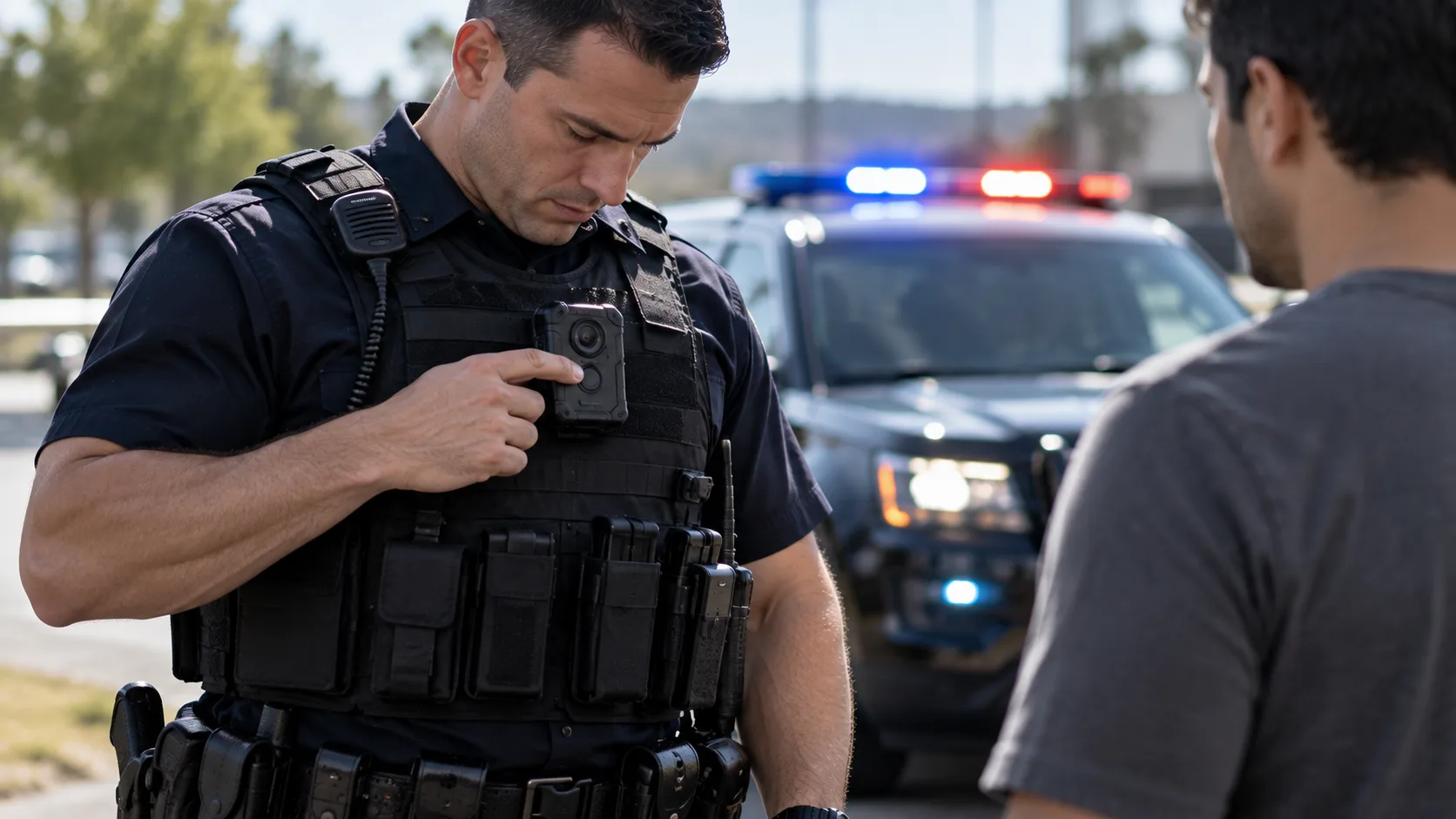
Police encounters · Body-worn cameras
Can Police Turn Off or Mute Their Body Cameras?
Police body-camera rules vary by agency. Learn when officers may stop recording, what muting means, privacy exceptions, and what happens if required footage is missing.
Independent educational reference. Not a police agency, hiring decision, or legal opinion.How we use sources.
Can police turn off or mute their body cameras?
Yes, but the better question is whether the officer was authorized to do so at that moment.
Body-worn cameras are governed by agency rules rather than one nationwide operating procedure. Departments decide which officers wear cameras, which encounters must be recorded, when recording may stop, which sensitive situations should not be recorded, and how officers document interruptions.
TheBureau of Justice Assistance body-worn camera guidancesays many departments require officers to continue recording until the encounter ends or until a supervisor approves deactivation. It also recommends that officers announce that recording is ending before turning the camera off.
That means seeing an officer touch the camera or hearing the recording stop is not enough to decide whether a policy violation occurred. You need the agency's current body-camera policy and the reason recording ended.
When are officers normally required to keep recording?
Required events vary, but common policies cover enforcement encounters where an accurate record has strong evidentiary or accountability value.
TheNYPD body-camera FAQsays officers must record events including uses of force, arrests, summonses, interactions with people suspected of criminal activity, searches of people or property, calls to crimes in progress, specified investigative actions, and interactions involving emotionally disturbed persons.
NYPD also states that events for which recording is required must generally be recorded from beginning to end.
Seattle similarly lists traffic and Terry stops, arrests, seizures, searches, suspect transport, pursuits, dispatched 911 calls, and questioning of suspects, victims, and witnesses among events normally recorded with body-worn video.
Those are department examples, not a national checklist. Another agency can use a different activation policy.
When may an officer deactivate the camera?
Policies commonly permit deactivation after the law-enforcement event is genuinely finished.
Seattle says officers can stop recording when the investigation is completed and there is little possibility of further contact with anyone involved in the event.
Federal policies can be more operationally specific. TheDepartment of Justice Office of Inspector General body-camera policysays agents conducting specified enforcement operations generally deactivate cameras only after an on-scene supervisor determines the scene is secure.
That policy also contains limited exceptions, including circumstances involving battery or storage conservation during long operations, emergency medical needs, personal matters such as restroom use, and some situations where an officer activated the camera without an on-scene supervisor.
The key point is that authorized deactivation normally comes from a written rule, a completed event, a privacy restriction, or a defined operational reason—not simply because an officer prefers not to be recorded.
Privacy can justify stopping or limiting recording
Body cameras create a tension between accountability and personal privacy.
Cameras can capture inside homes, hospitals, medical information, unclothed people, children, victims of sexual assault or domestic violence, death scenes, and highly personal conversations.
Seattle's public body-camera guidance says officers have discretion to stop video recording in some circumstances where privacy or dignity outweighs the need for video. Examples include natural-death scenes, death notifications, interviews with children or sexual-assault victims, cultural or religious objections, and situations where video would prevent a victim or witness from cooperating.
Seattle also has special rules for private residences. A resident or another person with legal standing may direct officers to stop video before entering in certain circumstances, although exceptions apply when officers have a warrant or a crime is in progress.
Importantly, Seattle says audio can continue in some situations where video is stopped. That illustrates why “the body camera was turned off” can be too imprecise a description.
Can officers mute only the audio?
Sometimes the technology can do it, but whether the officer is allowed to use that function is a separate issue.
Body-camera systems differ. Some recording systems support separate control of audio, video, buffering, or privacy functions. Agency policies may prohibit or restrict use of those features even if the hardware makes them available.
A useful caution comes from theU.S. Department of Justice investigation of the Phoenix Police Department. DOJ reported that Phoenix officers could use a camera muting function even though the policy then reviewed did not address muting. Investigators expressed concern about frequent muting, including after uses of force.
That example demonstrates why the existence of a mute button does not answer whether muting is authorized.
By contrast, NYPD says its current body-camera recordings cannot be paused. When the recording switch is deactivated, the camera returns to buffering rather than preserving continuous audio and video as an active recording.
If audio disappears while video remains, or vice versa, identify the camera system and agency policy before assuming deliberate misconduct.
Can a member of the public ask an officer to stop recording?
Yes, a person can ask. Whether the officer may grant that request is controlled by policy.
NYPD says that if a member of the public asks an officer to turn the camera off, the officer may consider doing so, but can continue recording when stopping would be unsafe or inadvisable. NYPD also says the officer cannot turn the camera off while a suspected perpetrator remains present at the scene.
Seattle gives more specific privacy-based discretion, particularly for victims, witnesses, residences, cultural concerns, and highly sensitive situations.
A driver or pedestrian therefore should not assume that saying “I don't consent to being recorded” automatically requires an officer to deactivate a body camera during a lawful enforcement encounter.
Body-camera recording and consent to a police search are separate legal and policy questions.
What if an officer turns the camera off when policy says it should stay on?
Improper deactivation can become an internal accountability issue.
Seattle states that employees must comply with department policies and that failures can be investigated by the Office of Police Accountability and can lead to discipline.
NYPD footage is also reviewed for issues such as late activation and early deactivation. A 2025 review by the New York City Comptroller described command-level and external review of footage for body-camera compliance as well as stop, frisk, search, and use-of-force issues.
The consequence depends on the jurisdiction and facts. It may involve supervisor review, retraining, internal investigation, discipline, evidentiary arguments, civil litigation, or other procedures.
Do not assume that every gap proves intentional misconduct. Batteries can fail, cameras can malfunction, an event may fall within a policy exception, or an officer may fail to activate the system through negligence rather than deliberate concealment.
Does missing body-camera footage automatically invalidate an arrest?
No general federal rule says that an arrest, citation, search, or prosecution automatically disappears because a body-camera recording is missing.
Body-camera compliance and the legality of the underlying police action are related but separate questions.
An arrest can be evaluated based on probable cause. A traffic stop can be evaluated based on its lawful justification. A search can be evaluated under consent, a warrant, probable cause, or another recognized rule. The absence of expected video can become important evidence in resolving factual disputes, but it does not automatically decide those underlying legal issues.
State law, local rules, court decisions, evidence-preservation duties, and the circumstances surrounding the missing footage can affect the consequences in a particular case.
If criminal charges are pending, provide the body-camera issue to defense counsel rather than assuming a policy violation automatically creates dismissal.
Can police departments tell when an officer stopped recording?
Modern body-camera systems can preserve significant system information in addition to the visible video.
Seattle says its body-camera video system maintains an audit log showing user actions involving video, including actions related to access, exporting, editing, and deletion. The department also says employees may not tamper with, alter, or delete original video except through established retention procedures.
NYPD's system similarly uploads stored recordings to a managed cloud environment after officers dock their cameras.
Depending on the system, investigators may therefore be able to review timing, activation, deactivation, upload, categorization, and access information when examining a disputed recording.
A public copy of a video may also be redacted. Blurred images or removed audio in a released copy do not necessarily mean the original evidence contains the same redactions.
What should you document if a body camera appears to be turned off?
Preserve facts rather than guessing about the officer's intent.
Write down the date, approximate time, location, agency, officer name or badge number if available, and what was happening immediately before and after you noticed the camera change.
Note whether the officer announced that recording was being stopped, whether another officer's camera was running, whether a patrol-car camera was present, and whether witnesses or other recordings exist.
If you later request records, identify the incident precisely enough for the agency to locate the footage.
OurPublic Records Request Letter Generatorcan help create a general request draft, but body-camera disclosure and retention rules vary by state and agency.
What to do next
Police can sometimes stop, deactivate, or limit body-camera recording, but the authority comes from the applicable policy and circumstances—not unrestricted officer discretion.
Start by identifying the agency and obtaining its current body-camera policy. Compare the type of encounter with the policy's required-recording, privacy, deactivation, and documentation provisions.
For the broader police encounter, readKnow Your Rights During a Police Stop. To request available footage or related records, use thePublic Records Request Letter Generator.
All Police Guide does not determine whether a particular officer violated policy or whether missing footage affects an individual criminal or civil case. Those questions require the actual policy, available recordings, system records, and applicable local law.
Frequently asked questions
Can police officers turn off their body cameras?
Sometimes, but only under the rules that apply to their agency. Many policies require officers to continue recording law-enforcement encounters until the incident ends, while allowing deactivation for privacy-sensitive situations, completed investigations, supervisor-approved reasons, or circumstances where recording is prohibited.
Can police mute their body-camera microphone?
That depends on the camera system and agency policy. Some departments or camera systems permit audio muting or separate video and audio treatment, while others do not. A technological mute function does not itself mean an officer is authorized to use it whenever they choose.
Can I tell an officer to turn off their body camera?
You can ask, but the officer may not be required or permitted to stop recording. Policies differ. NYPD allows officers to consider some public requests but says required events must generally be recorded from start to finish, while Seattle provides additional privacy-related rules for residences and sensitive encounters.
Does a body-camera policy violation make an arrest invalid?
Not automatically. A recording-policy violation can lead to administrative review or discipline and may affect evidence or litigation, but the validity of an arrest, search, or prosecution depends on separate law and facts.
Sources and verification
Use the linked source for its stated jurisdiction. Requirements and procedures can change; check the current agency notice before acting.
- NYPD: Body-Worn Cameras — Frequently Asked Questions checked
- Seattle Police Department: Body-Worn Video checked
- Bureau of Justice Assistance: Body-Worn Camera Training and Policy Guidance checked
- U.S. Department of Justice: Implementing a Body-Worn Camera Program checked
- DOJ Office of Inspector General: Body-Worn Camera Policies checked
- U.S. Department of Justice: Phoenix Police Department Findings Report — BWC muting checked
Found an error? Send the page URL and a supporting source to[email protected].